
Yes, get a mold inspection when buying a house if you see water stains, smell mustiness, or learn of past leaks. A general home inspection checks for visible mold only. A buyer-side mold inspection typically costs $300 to $1,000, according to Redfin. Book it inside your inspection window, before the contract deadline passes, so the results can still shape your negotiation.
Key Takeaways
- Get a mold inspection when you see mold, smell mustiness, find water stains, or live with asthma or allergies.
- A general home inspection looks for visible mold and moisture but takes no air or surface samples.
- A buyer-side mold inspection typically costs $300 to $1,000, with a national average near $680.
- Book the testing inside the 7 to 14 day inspection window so results arrive before the deadline.
- A positive result lets you ask for remediation, a credit, a lower price, or an exit if the contract allows.
- You can still test after closing, but you lose the negotiating power of the contract period.
Do You Need a Mold Inspection When Buying a House?
You need a mold inspection when buying a house if the home shows stains, odors, visible growth, or a leak history. Buyers with asthma or allergies have one more reason to test. According to the CDC, people with asthma or allergies may react severely to mold.
Hidden mold sits behind walls, under flooring, and inside crawl spaces, so a visual look can miss it. Adding a mold test to the visit gives you lab evidence before you commit.
The EPA says to dry water-damaged areas within 24 to 48 hours to prevent mold growth. A house with an old, unfixed leak has therefore had time to grow mold. The next question is what a general home inspection already covers.
Does a General Home Inspection Include Mold Testing?
A general home inspection does not include mold testing, because inspectors look for visible mold and moisture clues without taking samples. The ASHI Standards of Practice say an inspector is not required to report on molds and mold-like substances. Inspectors still note stains, damp materials, and poor ventilation.
General inspectors do not take air or surface samples. A general home inspection is also non-invasive, so hidden mold stays hidden until someone tests for it.
During an inspection for buyers, we look for visible moisture clues that feed mold. That visual work tells you whether a lab test is worth ordering. The signs below show when it is.
What Are the First Signs of Mold When Touring a House?
The first signs of mold when touring a house are a musty odor, water stains, peeling paint, and warped surfaces. Buyers can spot six warning signs during a showing.
- A musty or earthy odor in a basement, closet, or crawl space.
- Water stains on ceilings, walls, or around windows.
- Peeling paint or bubbling wallpaper.
- Warped flooring or damp, soft drywall.
- Condensation on windows or a bathroom fan that vents into the attic.
- Fresh paint on a single wall or ceiling patch.
Homes with basements and crawl spaces deserve extra attention, since those areas sit closest to soil moisture. Moisture under the floor shows up in the crawl space, so a crawl space inspection is worth the time.
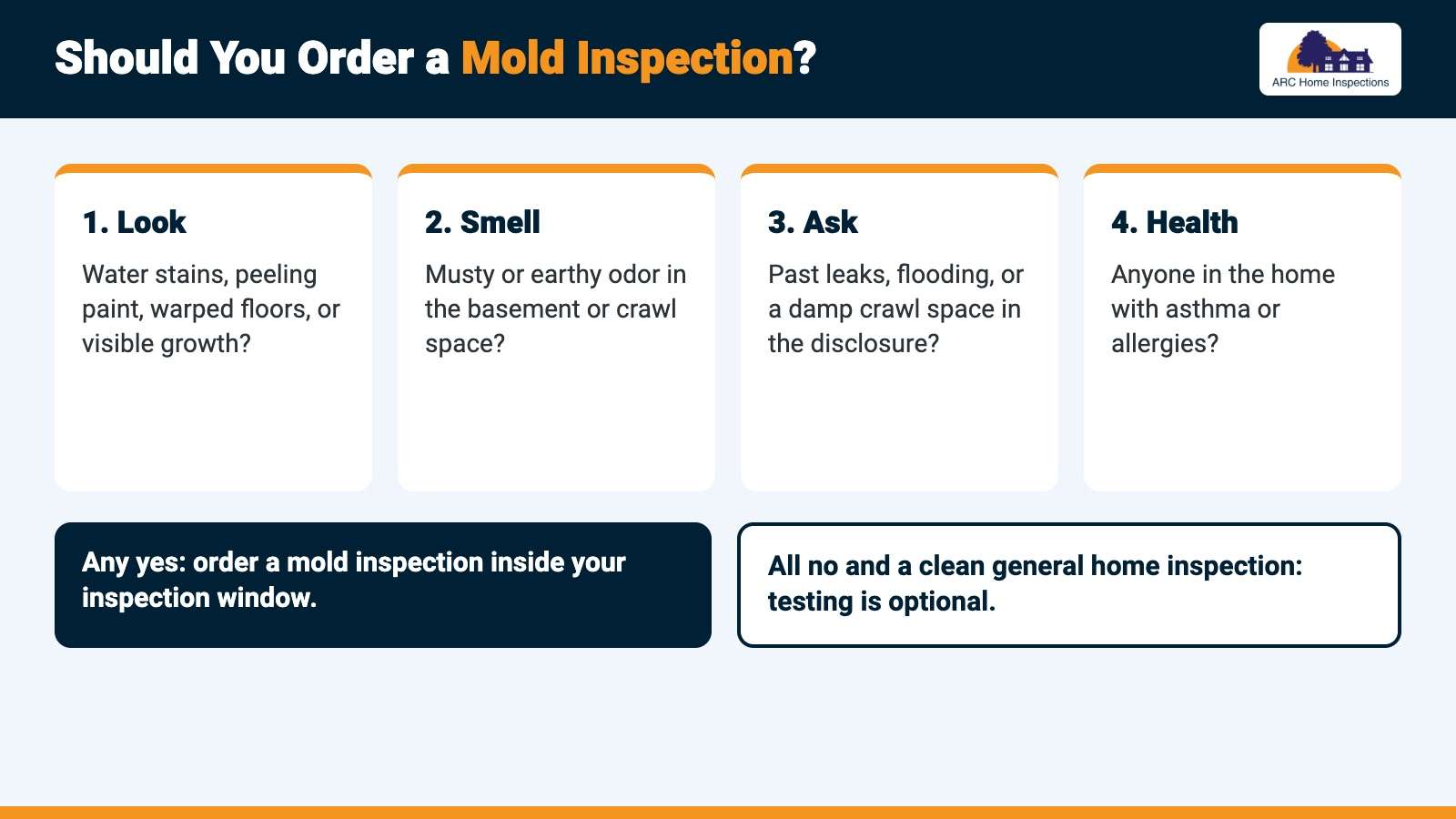
The decision flow above shows how these signs lead to a yes or no on testing. Once signs appear, the question becomes what a pre-purchase mold inspection actually covers.
What Does a Pre-Purchase Mold Inspection Cover?
A pre-purchase mold inspection covers a visual survey, moisture readings, and optional lab sampling of the areas where moisture collects. Ownerly reports that a house mold inspection takes 2 to 6 hours. The inspector checks the attic, basement, crawl space, bathrooms, and the HVAC system.
Inspectors use moisture meters and thermal cameras to find damp spots behind surfaces. Damp spots show where mold is likely to grow, even when nothing is visible yet.
A mold test before buying a house adds lab data to those visual findings. Buyers who want that data can add mold testing services to the same visit.
Air sample testing measures spores in room air and compares them with an outdoor sample. According to the EPA, no federal limits exist for mold or mold spores. The EPA also says sampling is usually unnecessary when mold is visible.
According to NIOSH, part of the CDC, routine air sampling is not recommended, and thorough visual inspections are more reliable. A lab number is therefore only a snapshot. The moisture findings explain the cause. The table states the main difference first: inspections find moisture, while tests measure spores.
| Option | What it shows | Reported cost | Source |
|---|---|---|---|
| Visual mold inspection | Visible growth and moisture sources | $300 to $1,000 | Redfin |
| Air sample test | Spore levels in room air | $300 to $550 | Ownerly |
| Surface swab | Mold type on one spot | $25 to $100 per sample | Inspection guide |
| Indoor air quality test | General air conditions | $150 to $350 | Inspection guide |
| HVAC-only test | Mold in the duct system | $50 to $80 | Redfin |
These options vary widely in price, so the next section covers how much a mold inspection costs for buyers.
How Much Does a Mold Inspection Cost for Buyers?
A mold inspection typically costs $300 to $1,000 for buyers, according to Redfin, with a national average near $680. Redfin lists homes under 4,000 square feet at $300 to $400. Homes over 4,000 square feet run $700 to $900.
Other sources report similar ranges, as the table shows. Local pricing varies, and a breakdown of mold inspection costs explains what drives each line.
| Source | Cost range | What it covers |
|---|---|---|
| Redfin | $300 to $1,000 (average about $680) | Typical home mold inspection |
| HomeLight, citing Angi | $302 to $1,039 | National estimate range |
| Ownerly | $294 to $1,011 | House mold inspection, 2 to 6 hours |
| Mold testing provider | $500 to $800, up to $1,500 | Pre-purchase inspection, large homes at the top |
Remediation costs more than testing, so the inspection fee is small next to a repair bill. HomeLight reports that remediation averages $1,150 to $3,400 and reaches $20,000 in severe cases. Redfin puts the average near $2,300, with many quotes from $1,200 to $6,000.
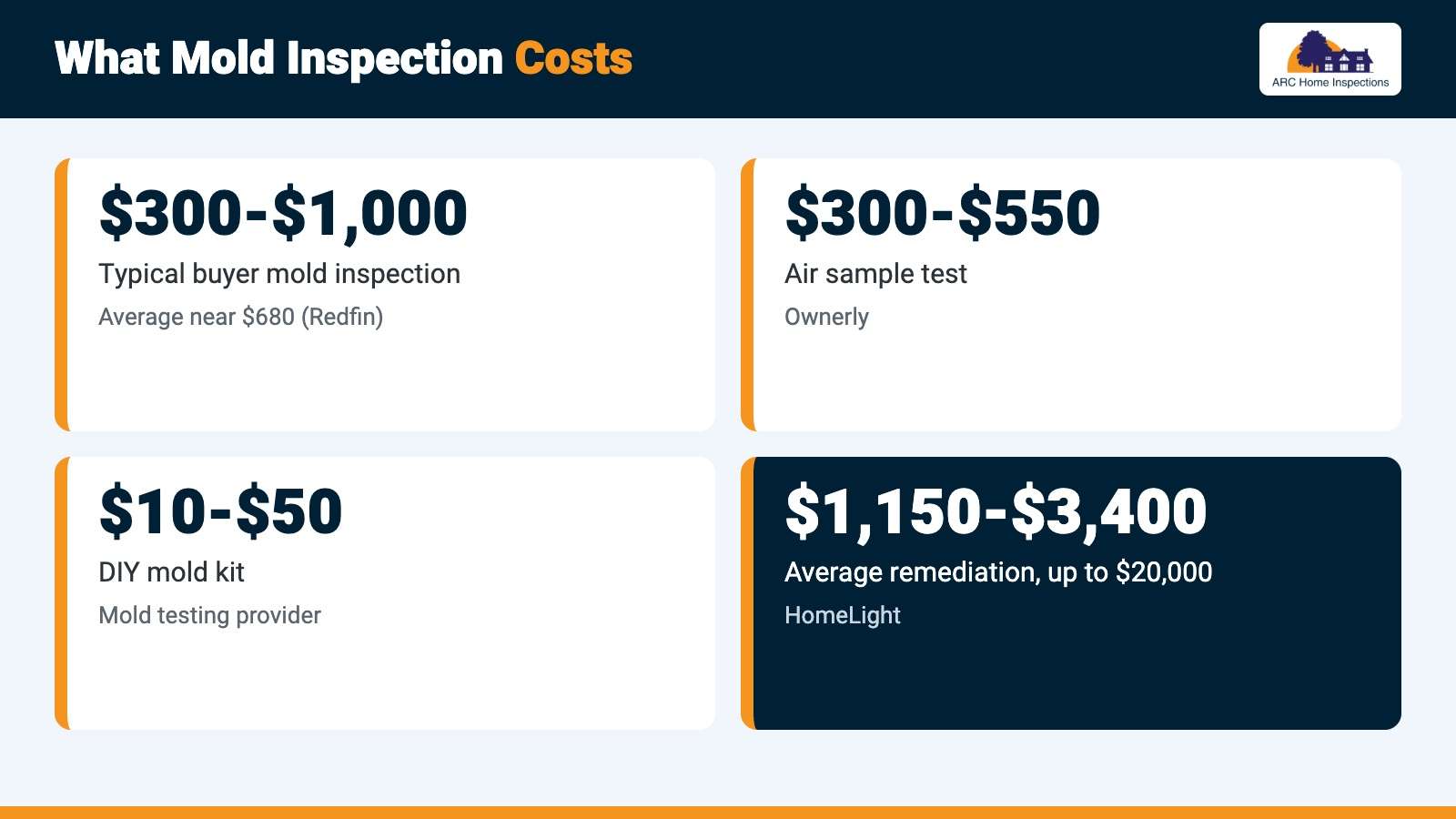
The graphic above compares the inspection fee with the remediation bill. Timing then decides whether those results can still change the deal.
When Should You Schedule the Mold Inspection?
Schedule the mold inspection inside the inspection window. One mold testing provider says buyers typically have 7 to 14 days after going under contract. The NAR consumer guide notes that inspections are not required. Buyers can add an inspection as a contingency.
The contract sets the exact inspection deadline, so confirm the date in writing. Lab turnaround then shapes the plan. The same provider lists 5 to 14 days for standard labs and 1 to 2 business days for fast labs.
Follow these five steps to fit mold testing inside the inspection window.
- Confirm the contract’s inspection contingency covers mold and moisture add-ons.
- Ask the seller’s agent for disclosure forms and any past leak records.
- Book the general home inspection and the mold add-on for the same visit.
- Choose the lab turnaround that fits the deadline, standard or fast.
- Send any repair or credit request in writing before the deadline.
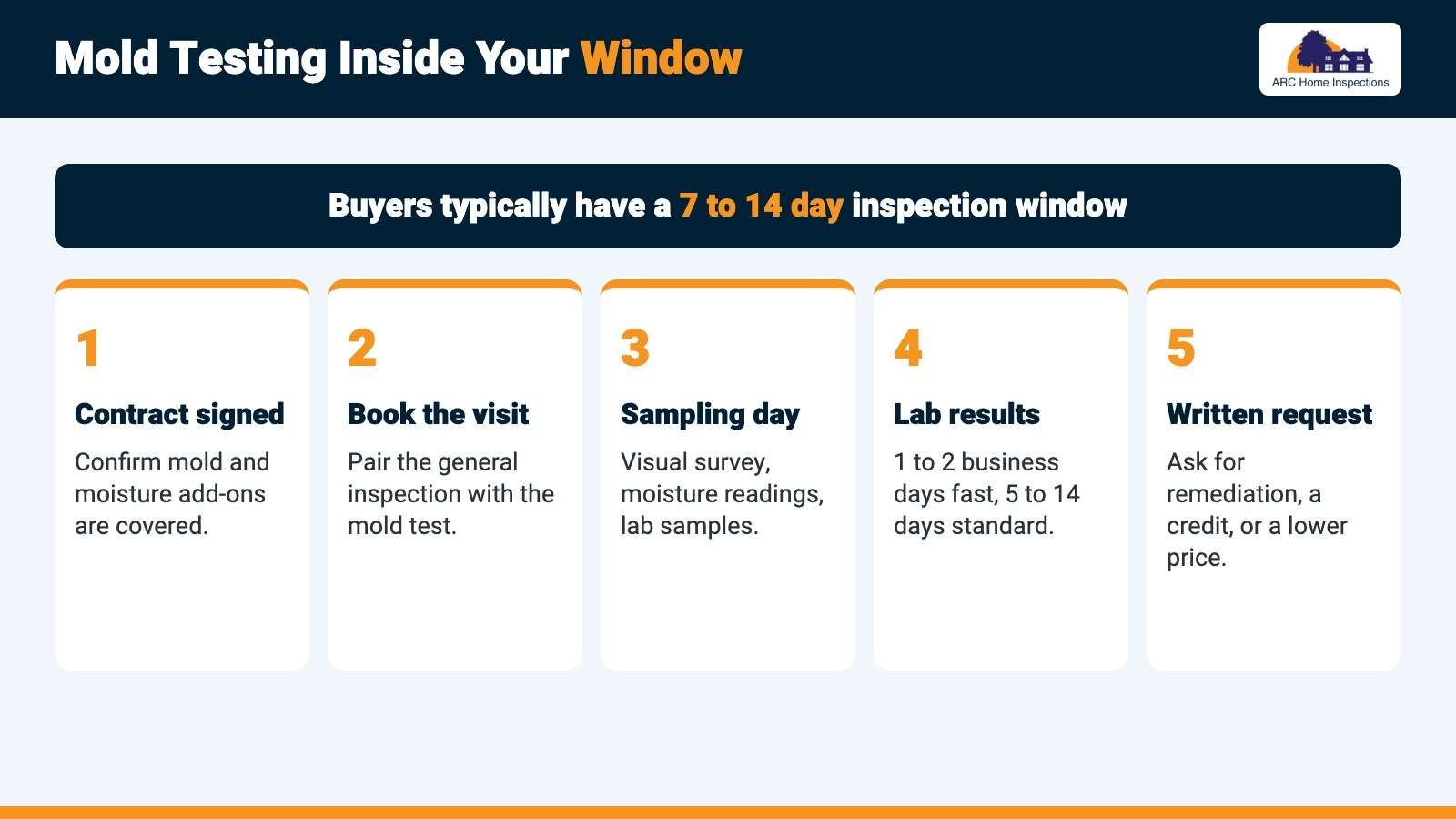
The timeline above places each step inside the window. The results then lead to the next question: what happens if the inspection finds mold.
How Do You Read a Mold Inspection Report?
You read a mold inspection report by checking the moisture findings first and the lab numbers second. A written report lists each room checked, the moisture readings, and any visible growth. Photos and notes mark the location of every finding.
Lab results show spore counts and mold types, usually next to an outdoor sample. According to the EPA, no federal limits exist for mold, so a count has no pass or fail line. The comparison with outdoor air gives the number meaning.
The moisture source matters more than the species name. A damp crawl space, a leaking pipe, or a poorly vented bathroom explains why mold grew. Fixing that source keeps the problem from returning. The guide to the inspection report covers the rest of the findings.
Ask the inspector to explain every flagged area before the deadline. Clear answers help you decide what to request from the seller. The next section covers what happens when the report does show mold.
What Happens If the Inspection Finds Mold Before Closing?
When the inspection finds mold before closing, you can ask for remediation, a credit, or a lower price. You can also walk away if the contract allows. Buyers choose the option that fits the size of the problem.
The EPA says homeowners can clean a patch under about 10 square feet, roughly 3 feet by 3 feet. Larger growth, HVAC contamination, or sewage water calls for a professional.
Remediation is done by a separate contractor, because inspectors diagnose and do not repair. Ask two or three remediation firms for written estimates before you decide.
Use the report to negotiate repairs in writing before the deadline. Some buyers still choose to skip testing, so the next section covers when that is reasonable.
Can You Skip a Mold Inspection When Buying a House?
You can skip a mold inspection when buying a house in low-risk cases. Low-risk cases mean a clean general home inspection, a dry crawl space, and no sensitive occupants. NIOSH says thorough visual inspections and musty odors are more reliable than air sampling. A clean visual report therefore counts as useful evidence.
Dry conditions lower the odds of growth. The EPA advises keeping indoor humidity below 60 percent, ideally between 30 and 50 percent.
Skipping the whole inspection is a different decision. NAR data shows 19% of buyers waived the inspection contingency, according to its September 2026 REALTORS Confidence Index. A waived contingency also removes the chance to negotiate repairs.
Can You Get a Home Inspection After Buying a House?
You can get a home inspection after buying a house, but you lose the negotiating power you had under contract. A post-closing mold test still shows what the house needs and sets a baseline. The repair bill then belongs to you.
Any claim against the seller depends on disclosure rules and the contract, so ask your agent before spending money. A post-purchase visit can also pair mold testing with moisture inspections to trace the water source.
What Else Should Buyers Know About Mold and Home Buying?
Buyers should know four more facts about mold and home buying, and each one is answered below.
What Time of Year Is Worst for Mold?
The worst time of year for mold is whenever indoor humidity climbs above 60 percent. Warm, humid weather makes that more likely. The EPA says to keep indoor humidity below 60 percent, ideally between 30 and 50 percent.
Is It Hard to Sell a House With Mold?
A house with documented mold is harder to sell, because buyers use the report to ask for remediation, credits, or lower prices. Sellers should ask their agent about disclosure rules.
Is It Mold or Mildew?
Mold and mildew differ in depth, because mildew is a surface growth while mold can reach deeper into materials. The guide on mold versus mildew explains how to tell them apart at home.
Should Buyers Pair Mold Testing With Other Tests?
Buyers should pair mold testing with other tests when the home has a basement, a well, or a septic system. Each of those systems carries a hazard that mold testing does not cover, such as a radon test for basement air.
Frequently Asked Questions About Mold Inspections for Buyers
What Is the Biggest Red Flag in a Home Inspection?
The biggest red flag in a home inspection is active water intrusion, because moisture damages structure and feeds mold. Roof leaks, foundation seepage, and plumbing leaks all fit that description. Each one raises the odds of hidden mold.
Is It Okay to Buy a House Without an Inspection?
It is possible to buy a house without an inspection, but the buyer then owns every hidden defect, including mold. NAR says home inspections are not required, though buyers can include one as a contingency.
Is a DIY Mold Kit Enough?
A DIY mold kit is not enough for a purchase decision, because it samples only one spot. A mold testing provider lists kits at $10 to $50, while Ownerly lists about $40.
How Long Does a Mold Inspection Take?
A mold inspection takes 2 to 6 hours, according to Ownerly. Fast labs return results in 1 to 2 business days. Standard labs take 5 to 14 days, per a mold testing provider.
How Can We Help You Check a House for Mold?
We help you check a house for mold with a mold test, moisture readings, and thermal imaging during one visit. The team at ARC Home Inspections reports the findings in writing. A separate contractor handles any remediation, so the report stays independent of the repair quote.
A mold inspection when buying a house gives you facts before the deadline. Schedule a professional mold test or call (314) 948-3058.