
No, FHA does not require a termite inspection on every home purchase. HUD Handbook 4000.1 requires one only when a factor applies: local custom, a state or local mandate, active infestation, or lender discretion. The appraiser watches for termite signs on the visit. The report stays valid for about 90 days, and a typical inspection costs around $100.
Key Takeaways
- FHA requires a termite inspection when one of four HUD factors applies to the property.
- The FHA appraiser looks for termite signs but does not perform a pest inspection.
- The NPMA-33 form documents the inspection, and the report is good for about 90 days.
- Termite treatment and repairs must finish before the lender approves the loan.
- FHA and VA do not require radon testing on a typical purchase, but the EPA sets 4 pCi/L as the action level.
Does FHA Require a Termite Inspection When You Buy a Home?
FHA does not require a termite inspection on every home purchase. The Department of Housing and Urban Development (HUD) sets the rule in Handbook 4000.1, effective October 15, 2019. The handbook ties the requirement to the property, not to the loan itself. A termite inspection becomes mandatory only when one of four listed factors applies.
Buyers who want a clear answer before the appraisal can order a wood destroying insect inspection early. We perform this wood-destroying organism (WDO) inspection as a standalone service, so the report is ready when the lender asks for it. The next section lists the four factors one by one.
When Does an FHA Loan Require a Termite Inspection?
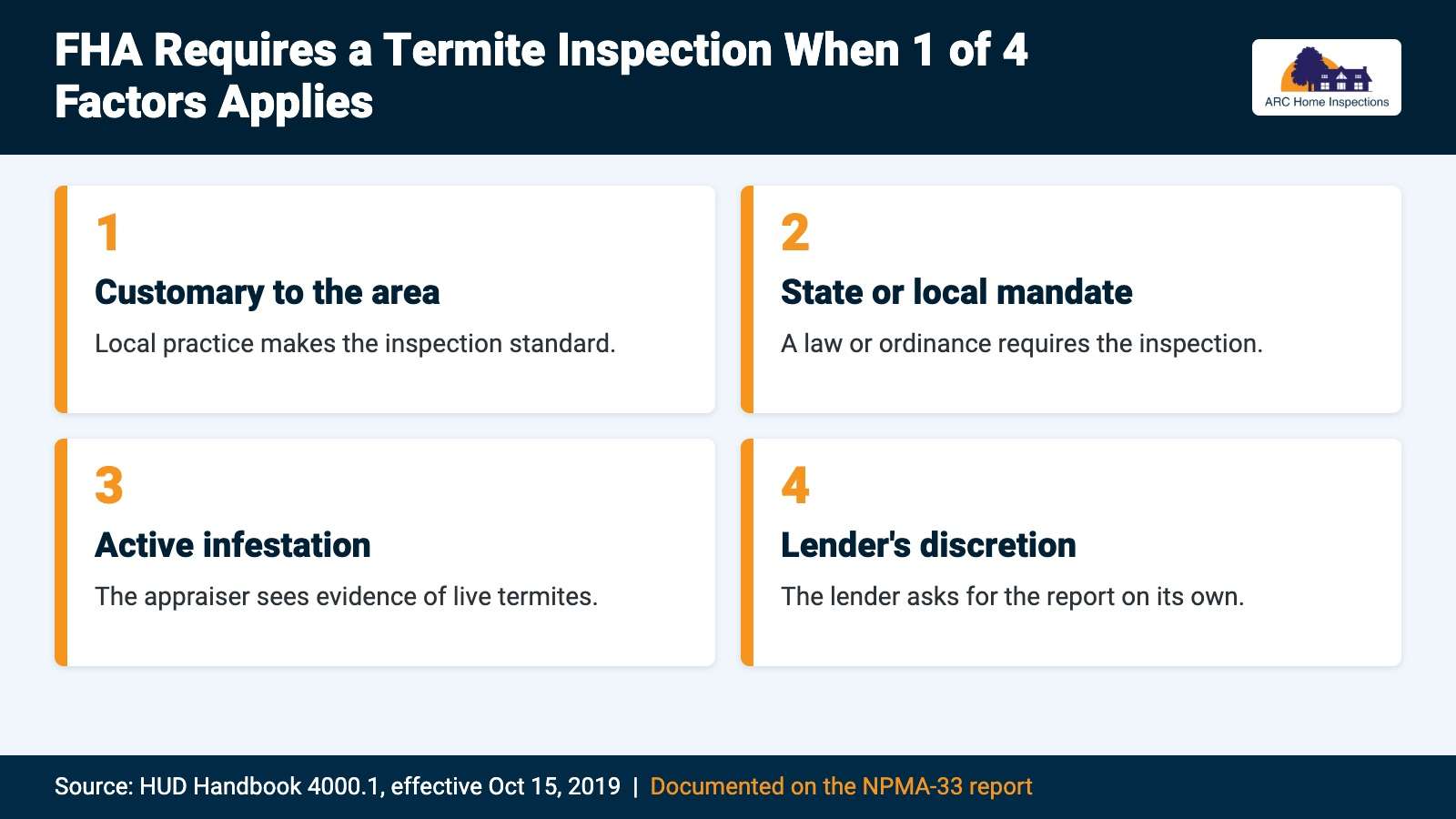
An FHA loan requires a termite inspection when any one of four factors applies. According to HUD Handbook 4000.1, the four factors are listed below.
- The inspection is customary to the area, so local practice makes it standard for home sales.
- The state or local jurisdiction mandates the inspection by law or ordinance.
- The appraiser sees evidence of active infestation during the visit.
- The lender asks for the inspection at its own discretion.
The National Pest Management Association (NPMA) summarizes the handbook the same way. The NPMA states that the inspection and its documentation are required when any of these factors apply. A single trigger is enough, so the other three factors do not need to be present.
The third factor puts the appraiser in charge of spotting trouble. That role leads straight to what an FHA appraiser actually checks.
What Does an FHA Appraiser Check for Termites?
An FHA appraiser checks for termites by looking for signs of infestation and damage during the property visit. According to the NPMA, appraisers must observe all areas of the house and other structures on the property. The appraiser reports signs of termites but does not diagnose them.
Freedom Mortgage explains the next step. When the appraiser sees evidence, a professional inspection must be completed, and repairs must be done before the loan is approved. The appraiser therefore acts as the trigger, while a pest inspector confirms what is happening.
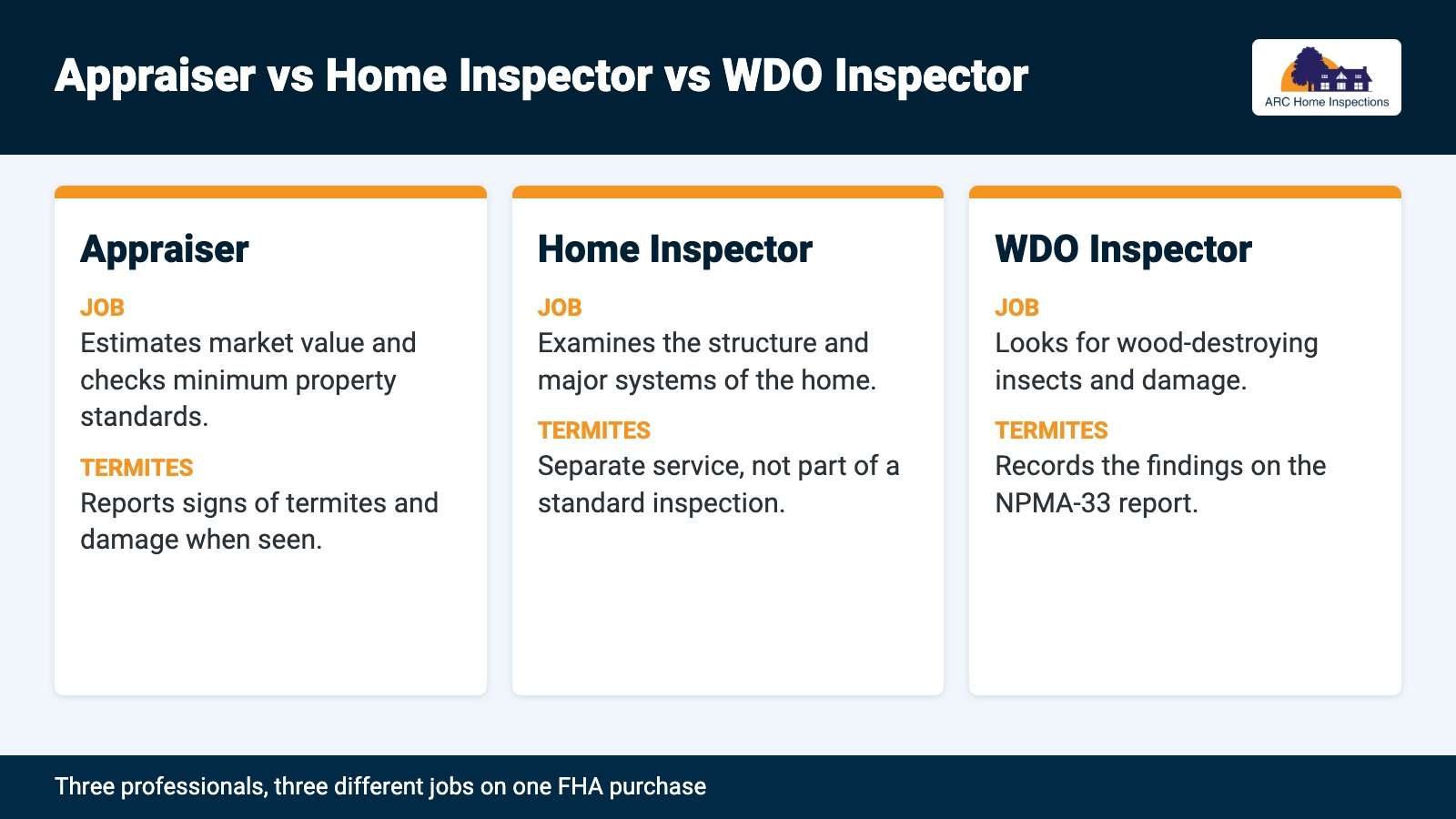
An appraisal and an inspection do different jobs. The appraiser estimates market value and checks the home against minimum property standards. A home inspector examines how the structure and systems perform. Our guide to the home inspection and appraisal difference explains that split in detail.
The graphic below compares the three jobs side by side. A third professional, the WDO inspector, covers the pest question that neither of the other two answers in full.
The WDO inspector records the findings on a standard form. That form is the next topic.
What Is the NPMA-33 Form for an FHA Loan?
The NPMA-33 is the standard wood-destroying insect report that documents an FHA termite inspection. According to the NPMA, the report must be submitted whenever an active infestation is identified. Some states use their own state form in place of the NPMA-33. The report turns the inspector’s findings into a document the lender can review.
The report records four findings about the home:
- Live wood-destroying insects, if the inspector found any.
- Evidence of past activity or past treatment.
- Visible damage to wood.
- Areas that were blocked or inaccessible during the visit.
Each finding matters because the lender reads the report before approving the loan. A report with live insects or damage leads to the next question for buyers: what happens after a positive finding.
What Happens If an FHA Termite Inspection Finds Termites?
An FHA termite inspection that finds termites leads to treatment and repairs before the loan is approved. Freedom Mortgage states that the repairs must be done before the lender approves the loan. Treatment and repairs must finish before the lender approves the loan.
The recovery path follows the same order on each purchase:
- The inspector documents the findings on the report.
- A licensed pest control company treats the infestation.
- A contractor repairs the damaged wood.
- The buyer or lender confirms the work is complete before closing.
We inspect and report only, so we do not treat termites or repair wood. A re-inspection can confirm that completed repairs match the report. That follow-up visit gives the buyer proof before closing day.
Treatment costs vary widely. Homeowners often pay between $200 and $900 for professional termite management, according to HomeAdvisor figures cited by Freedom Mortgage. Whole-structure tenting costs $1,200 to $2,500 under the same figures.
Buyers can use the report to negotiate repairs with the seller. That negotiation raises the question of who pays for the inspection itself.
Who Pays for an FHA Termite Inspection?
The buyer or the seller pays for an FHA termite inspection, depending on the purchase contract. FHA rules do not assign the fee to either side. The contract decides who pays, and the two sides can negotiate it.
The fee itself is small compared with the loan. Termite inspections can often cost around $100, according to Freedom Mortgage. Veterans United reports $100 to $200 for VA inspections, with the price varying by home size, location and severity.
Our separate guide shows who pays for termite inspection costs in the buyer-versus-seller split. The cost is only one part of the timeline, because the report also expires.
How Long Is a Termite Inspection Good for on an FHA Loan?
A termite inspection report is good for about 90 days on an FHA loan. Valoan Network states that a standard NPMA-33 report must be used within 90 days of the inspection date. Chase says termite reports are usually valid for 90 days. Order the inspection so the 90-day window covers the closing date.
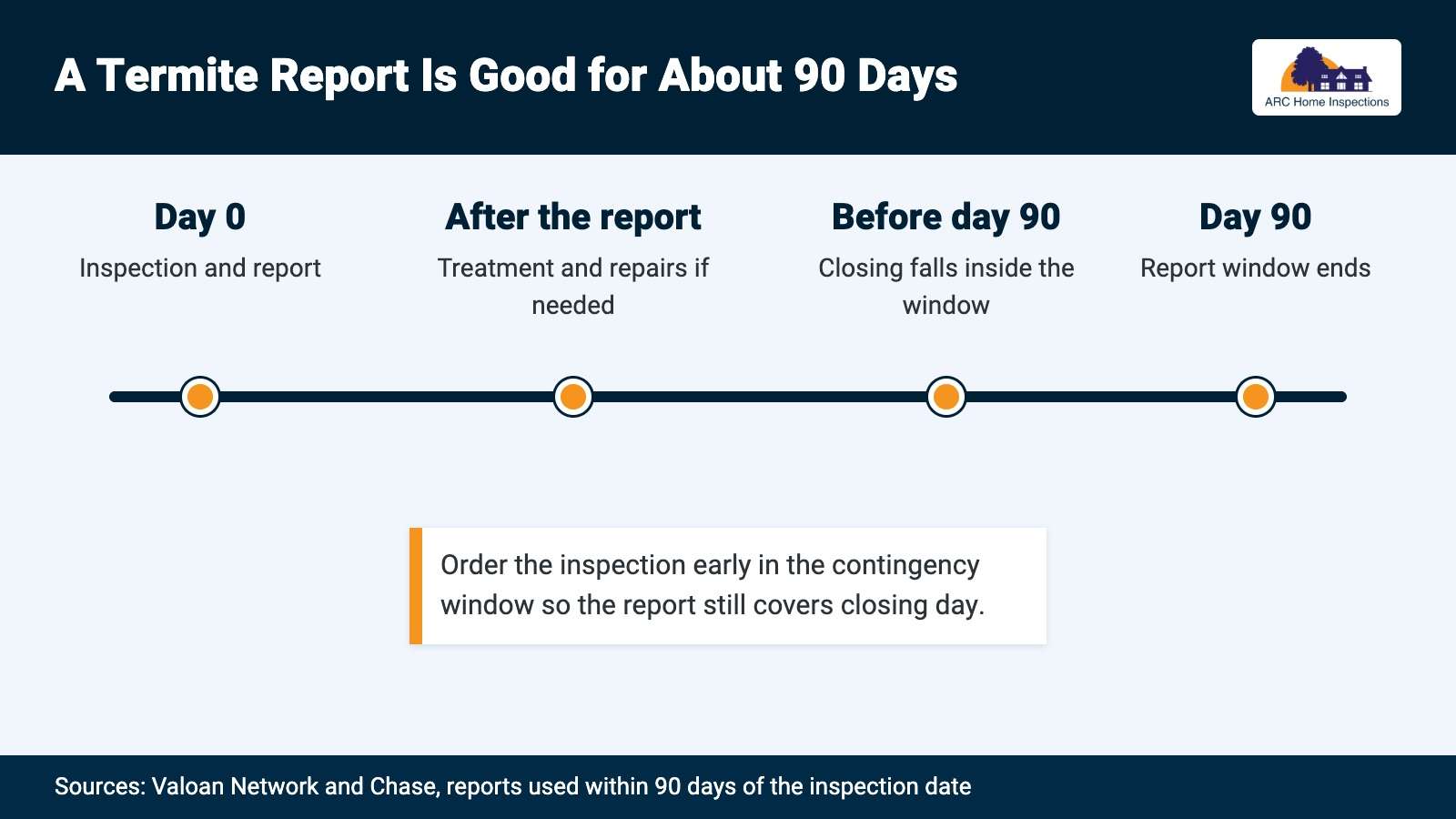
An inspection ordered too early can expire before closing. An inspection ordered too late can delay the closing itself. Ordering early in the contingency window leaves time for treatment and repairs if the report finds a problem.
The same timing logic applies across loan types, so the next section compares FHA with VA and conventional loans.
How Does FHA Compare With VA and Conventional Loans on Termite Inspections?
FHA compares with VA and conventional loans on termite inspections mainly in how the requirement starts. FHA starts with four HUD factors tied to the property, while VA starts with the location of the home. Conventional loans leave the decision to the lender and the purchase contract.
| Loan type | When an inspection is required | Who may pay |
|---|---|---|
| FHA | Only when one of the four HUD factors applies | Set by the purchase contract |
| VA | In states and counties with higher termite risk, including Missouri on lender state lists | Since June 2022, the veteran may pay for the inspection and required repairs |
| Conventional | When the lender or the purchase contract asks | Set by the purchase contract |
The VA row is a short summary only. Veterans can find the full rules in our guide to VA termite inspection rules. Confirm the current requirement with the lender before ordering any report.
Termite rules are only one of the property checks buyers ask about. Radon is the other one that appears beside FHA questions.
Does FHA Require Radon Testing When You Buy a Home?
FHA does not require radon testing on a typical home purchase, and neither does VA. State or local rules, or an individual lender’s policy, can still require a test. The EPA recommends fixing a home when radon levels exceed 4 picocuries per liter (pCi/L).
Radon is a radioactive gas that rises from the soil into homes. According to the EPA, radon is the second leading cause of lung cancer. The EPA estimates that radon causes about 21,000 lung cancer deaths every year. About 2,900 of those deaths are among people who never smoked.
EPA Zone 1, the highest-risk category, covers northwestern Missouri. Buyers anywhere in the state can add a radon test to the purchase inspections. The test is optional under FHA rules, which brings up a broader question about optional inspections.
Should You Get a Termite Inspection Even When FHA Does Not Require One?
Yes, a termite inspection is worth ordering even when FHA does not require one. Termites cause an estimated $6.8 billion in property damage each year in the U.S., according to the NPMA. The inspection costs far less than the treatment and repairs it can prevent.
The cost gap is clear from the figures above. An inspection runs around $100, while treatment runs $200 to $900 and tenting runs $1,200 to $2,500. Repairs to damaged wood come on top of those amounts. Our guide on whether a termite inspection is worth the cost walks through the math.
The inspection also protects buyers on loans that never trigger it. A buyer with a conventional or FHA loan and no trigger would otherwise close with no pest documentation. The report fills that gap, and it gives buyers a basis to ask for repairs or a price change.
What Else Should FHA Buyers Know About Termite Inspections?
FHA buyers should know five short answers about termite inspections, listed below.
What Pests Does a WDO Inspection Cover?
A WDO inspection covers termites and other wood-destroying insects. Carpenter ants, carpenter bees and powderpost beetles fall in the same group. The inspector checks accessible areas and records the results on the standard form.
What Do Termite Inspectors Look For?
Termite inspectors look for mud tubes, damaged wood, discarded wings and live insects. They check the foundation, crawl spaces, attics and wood near the ground. The guide on how termite inspections work covers each area in order.
Does a Clear Termite Report Mean a Home Is Termite-Free?
No, a clear termite report means the inspector found no evidence in accessible areas on the inspection day. Termites can arrive after the visit, and hidden areas stay out of reach. The report is a snapshot of the home on that date, so the 90-day window matters.
Is a Home Inspection the Same as a Termite Inspection?
No, a home inspection and a termite inspection are separate services. A buyers inspection covers the structure and major systems. A termite inspection focuses on wood-destroying insects and produces its own report.
Does FHA Require a Termite Inspection for a Condo or Townhome?
Yes, FHA applies the same four-factor rule to a condo or townhome. The handbook ties the requirement to the property and its location, so the lender confirms which factors apply to the unit.
Frequently Asked Questions
Frequently asked questions about FHA termite inspections cover appraisals, refinances and VA loan rules.
Can You Get an FHA Loan Without an Inspection?
Yes, FHA does not require the buyer to order a home inspection, but it does require an appraisal. The appraisal estimates value and checks property standards. A home inspection is a separate, optional step that protects the buyer.
What Will Disqualify a Home From an FHA Loan?
Active termite damage that affects the structure can disqualify a home from an FHA loan until the repairs are done. According to Freedom Mortgage, the repairs must be done before the loan is approved. Other minimum property standard problems can also hold up the loan.
Does FHA Require a Termite Inspection on a Refinance?
FHA requires a termite inspection on a refinance only when the four HUD factors or the lender’s rules apply. Each lender sets its own documentation rules, so confirm the requirement before ordering a report.
Does VA Require a Termite Inspection?
Yes, VA requires a termite inspection in designated states and counties. According to Chase, inspections are typically required where the Termite Infestation Probability Map shows moderate to heavy or very heavy risk.
Does VA Require a Termite Inspection on a Refinance?
VA requires a termite inspection on a refinance depending on the loan type and the location. According to Chase, termite inspections typically are not required for VA streamline loans, also known as IRRRLs.
How Does ARC Help FHA Buyers With Termite Inspections?
ARC helps FHA buyers with termite inspections by documenting the home’s condition before closing. At ARC Home Inspections, we perform WDO inspections for buyers across Missouri. We inspect and report only, so the buyer takes any treatment or repair work to a licensed contractor.
Our WDO termite inspection gives the lender and the buyer a documented report before the closing date. Buyers can call (314) 948-3058 to schedule the inspection.