Well water testing costs $75 to $200 for a basic homeowner panel at a commercial lab, according to one national lab guide. A bacteria-only test runs $40 to $80, and a broad panel runs $250 to $600 or more. Public and university labs charge less, with one state lab listing $35 for coliform bacteria. The price depends on the panel, the lab, and the reason for the test.
Key Takeaways
- A basic homeowner panel costs $75 to $200 at commercial labs, and bacteria alone costs $40 to $80.
- Broad panels cost $250 to $600 or more, and PFAS testing adds roughly $200 to $600.
- Home sale tests cost $100 to $350, depending on the lender package and lab.
- County health departments and university labs offer the lowest prices, from free to $75.
- The CDC and EPA say to test every year for coliform bacteria, nitrates, total dissolved solids, and pH.
- Home strip kits cost $15 to $50 but cannot reliably detect bacteria, arsenic, or lead.
How Much Is Well Water Testing?
Well water testing costs $75 to $200 for a basic homeowner panel, according to a commercial lab guide. That same lab lists $40 to $80 for a bacteria test on its own. One California well service updated its prices in February 2026. It lists $25 to $50 for bacteria and $75 to $150 for a basic panel.
Comprehensive panels cover metals, minerals, and chemicals, so that lab prices them at $250 to $600 or more. Homeowners who want an inspector to collect the sample can book well water testing with us. The inspector delivers the sample to a certified lab.
Three factors set the final price: the number of contaminants, the type of lab, and the reason for the test. The next section breaks the well water testing cost down by test type.
What Does Each Type of Well Water Test Cost?
Each type of well water test costs between $10 and $600, depending on how many contaminants the lab measures. A single-contaminant test sits at the low end. A broad panel with dozens of contaminants sits at the high end.
The table below lists typical commercial lab prices from two published cost guides.
| Test | Typical price | Source |
|---|---|---|
| Bacteria test (coliform and E. coli) | $40-$80 | Commercial lab |
| Bacteria test, low-cost labs | $15-$40 | Cost guide |
| Nitrate | $10-$30 | Cost guide |
| Arsenic | $20-$50 | Cost guide |
| Lead | $20-$50 | Cost guide |
| Homeowner panel | $75-$200 | Commercial lab |
| Volatile organic compounds (VOCs) | $100-$250 | Cost guide |
| Broad panel | $250-$600 or more | Commercial lab |
| PFAS (forever chemicals) | $300-$600 | Cost guide |
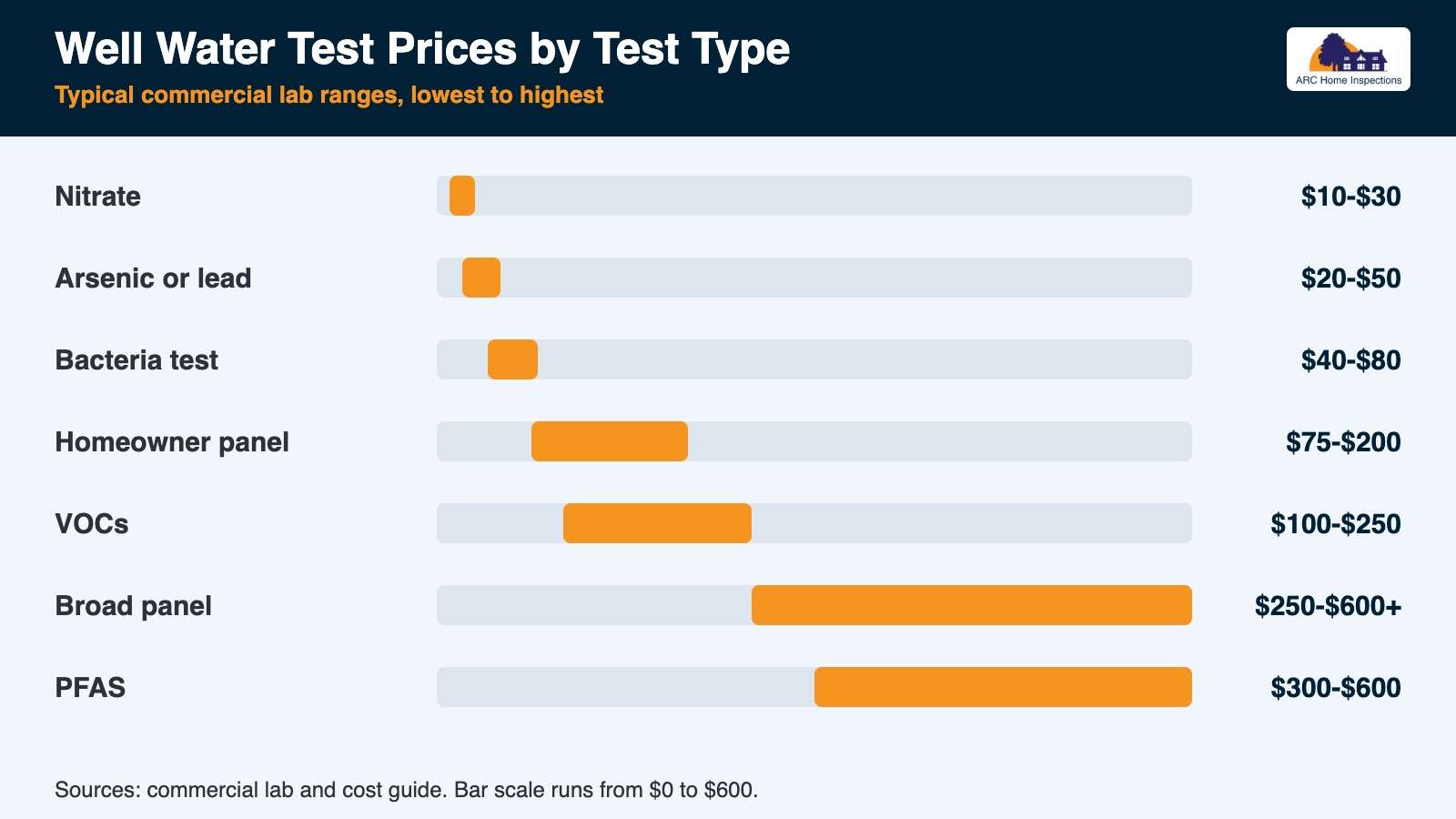
These prices cover lab fees, and the commercial lab adds a collection fee to its real estate range. The graphic below ranks the same tests from lowest to highest price.
Why Do Well Water Test Prices Vary So Much?
Well water test prices vary so much because each panel measures a different set of contaminants at a different lab. That commercial lab lists five cost drivers. The number of contaminants measured is the biggest driver, since each added contaminant adds lab work.
- Parameter count: the number of contaminants in the panel.
- Instrument: advanced equipment for metals and PFAS costs more to run.
- Shipping and hold times: samples must reach the lab quickly.
- Chain of custody: signed sample tracking adds paperwork for real estate tests.
- Turnaround: rush results cost more than standard results.
Understanding how testing works explains why a bacteria test costs less than a metals panel. Bacteria need one sterile bottle and a short hold time. Metals and chemicals need extra bottles and extra instruments. A broad panel therefore costs several times more than a bacteria test.
How Much Is Well Water Testing for a Home Sale?
Well water testing for a home sale costs $100 to $200 in one cost guide. A commercial lab lists $150 to $350. Package type sets the price, because lenders and agents ask for different contaminants. The Wisconsin State Laboratory of Hygiene lists its HUD, FHA, and VA loan package at $146 with a 7-day turnaround.
Rush service doubles that price. The same Wisconsin lab lists the rush fee for the loan package at $292. Buyers who plan ahead avoid the rush fee. Booking the sample early also leaves room for a retest before the closing date.
The purchase contract decides whether the buyer or the seller pays. Buyers can request certified well water testing during the inspection window, so results arrive before the contract deadline. The lab report lists each contaminant with its measured level, which gives the buyer and the lender the same numbers.
Scheduling the water test alongside a buyers inspection keeps the sample collection and the inspection on one timeline. Real estate tests also differ from yearly homeowner tests, so the cost of each one is covered separately.
Where Can You Get Well Water Tested for Free?
Some county health departments offer well water testing free or up to $75, according to a published cost guide. County health departments and university labs offer the lowest prices. Many of these programs run through extension offices or state labs.
The table below shows published fees from two public labs.
| Laboratory | Test or package | Price |
|---|---|---|
| Wisconsin State Laboratory of Hygiene | Bacteria (total coliform and E. coli) | $35 |
| Wisconsin State Laboratory of Hygiene | Nitrate | $35 |
| Wisconsin State Laboratory of Hygiene | HUD, FHA, and VA loan package | $146 |
| Wisconsin State Laboratory of Hygiene | Homeowner package (5-bottle kit) | $450 |
| Penn State Agricultural Analytical Services Lab | Standard drinking water package | $60 |
| Penn State Agricultural Analytical Services Lab | Trace package | $130 |
| Penn State Agricultural Analytical Services Lab | Extensive package | $220 |
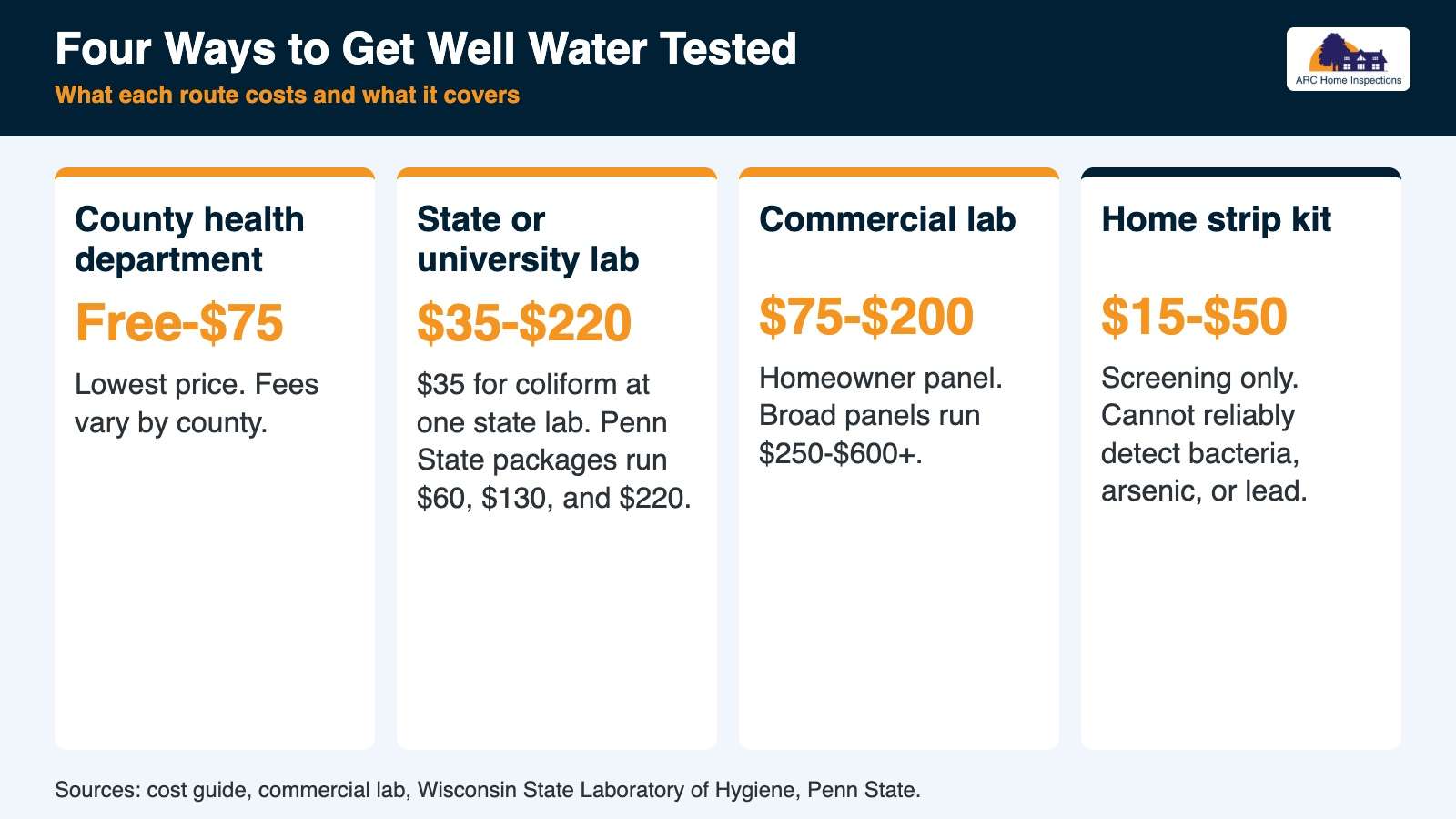
Wisconsin’s prices took effect July 1, 2026, and labs change fees over time. Missouri well owners should confirm current fees with their state health department or a certified lab. The graphic below compares the four main testing routes.
Can You Test Well Water Yourself?
Yes, you can test well water yourself, but home strip kits cannot reliably detect bacteria, arsenic, or lead. One cost guide lists strip kits at $15 to $50, and a commercial lab lists hardware store kits at $10 to $30. Strip kits work only as a screening step, so a lab result still decides whether the water is safe.
The EPA says to use only laboratories certified for drinking water testing. A certified lab also supplies the sterile bottle and the instructions for the sample. Mail-in lab kits let homeowners collect the sample at home and ship it back. The lab then reports each contaminant as a measured level, not a color change.
A lab-based water quality test costs more than a strip kit, but the lab reports exact numbers for each contaminant. Sampling mistakes, such as touching the bottle opening, can spoil a bacteria result and force a retest.
Is Well Water Testing Worth the Cost?
Well water testing is worth the cost because private well owners must deliver safe drinking water, according to the EPA. The EPA estimates that more than 23 million households rely on private wells in the United States. Private wells are not regulated by the federal government, so no agency tests the water for the owner.
One commercial lab budgets $250 to $500 for a new well baseline and $40 to $90 per year after that. The same lab says a $45 bacteria recheck is common after a $200 panel. Yearly testing keeps a record, so a change in nitrate or bacteria shows up early.
A positive result means the lab found bacteria or a contaminant above a safe limit. The owner then treats the well, retests the water, and confirms the fix.
How Often Should You Test Well Water?
You should test well water every year for total coliform bacteria, nitrates, total dissolved solids, and pH, according to the CDC. The EPA gives the same four tests and adds that homes with small children or elderly adults need more frequent testing.
The CDC names five events that call for an extra test.
- Any repair or replacement of a well system part.
- A change in taste, color, or smell.
- Flooding or land disturbance near the well.
- Pregnancy in the household.
- A child starting to live in the home.
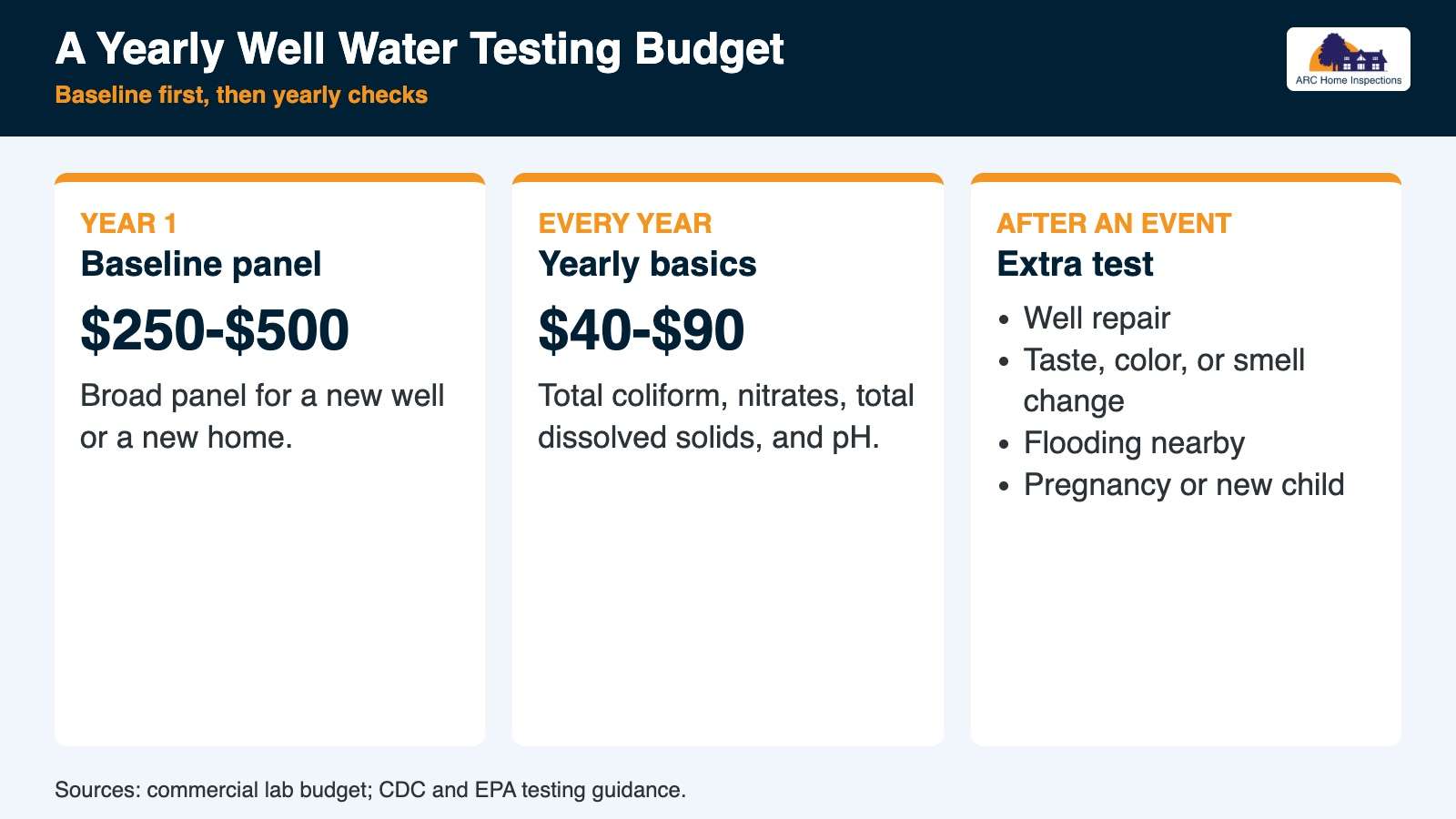
The CDC also says to check the well for mechanical problems every spring. A spring check and a yearly lab test together cover both the equipment and the water. The graphic below shows how a typical testing budget spreads across the first year and the years after.
How Can You Lower the Cost of Well Water Testing?
You can lower the cost of well water testing by matching the panel to the real risk. Follow these steps to avoid paying twice:
- Call the county health department first and ask about free or low-cost tests.
- Order the yearly bacteria and nitrate tests that the CDC recommends.
- Buy a broad panel only once, to set a baseline for metals and chemicals.
- Compare what each panel includes, because a commercial lab frames price as cost per contaminant.
- Choose a certified lab, because the wrong test means paying for a second one.
A matched panel costs less than two separate tests. The same logic applies to PFAS testing, which the next section covers along with other buyer questions.
What Else Should Buyers Know About Well Water Testing Costs?
Buyers should know that well water testing costs depend on the lab, the panel, and the sale timeline. The short answers below cover common buyer questions.
Does a Home Inspection Include Well Water Testing?
A home inspection does not include lab well water testing, because water quality needs a certified lab analysis. Buyers who order a full home inspection should budget the water test as a separate line item.
How Long Do Well Water Test Results Take?
Well water test results take 2 to 3 business days at one state lab. The Wisconsin State Laboratory of Hygiene lists 2 business days for bacteria and 3 days for nitrate. Its loan package takes 7 days.
Does Well Water Testing Cost Differ by State?
Well water testing cost differs by state because each public lab sets its own fees. The Wisconsin State Laboratory of Hygiene charges $35 for bacteria, while Penn State’s standard package costs $60. Commercial labs set separate prices again, so compare at least two quotes.
What Is the Cheapest Way to Test Well Water?
The cheapest way to test well water is a county health department or a state laboratory. County programs range from free to $75, according to a published cost guide. A state lab bacteria test at $35 follows as the next lowest price.
Should You Test for PFAS?
You should test for PFAS only when local risk warrants it. One cost guide lists PFAS tests at $300 to $600, and a commercial lab lists a PFAS add-on at $200 to $500.
What Do Well and Septic Inspections Cost Together?
Well and septic costs add together because each system needs its own test. Each service answers a different question. A septic system inspection checks the tank and drain field, while a water test checks the water. Lenders may ask for both before closing.
Buyers in Missouri can compare totals in a well and septic inspection cost breakdown.
Frequently Asked Questions About Well Water Testing Costs
Is It Expensive to Have Well Water Tested?
Having well water tested is not expensive for the basic tests. A bacteria test costs $40 to $80 at a commercial lab, and nitrate costs $10 to $30 according to a cost guide. Broad panels and PFAS tests cost more.
Is a Well Inspection Worth It?
A well inspection is worth it before a purchase, because it checks the well equipment while a water test checks the water. The two checks answer different questions. A buyer needs both before closing.
What Does Well Water Need to Be Tested For?
Well water needs to be tested for total coliform bacteria, nitrates, total dissolved solids, and pH every year, according to the CDC. Add arsenic, lead, or other contaminants when local conditions call for them.
What Are Signs of Poor Water Quality?
Signs of poor water quality include a change in taste, color, or smell, according to the CDC. Any of these changes calls for a new test. Clear water can still carry bacteria, so a lab result is the only reliable check.
Is a Cheap Water Test Better Than No Test?
A cheap water test is better than no test only when it measures the right contaminants. A strip kit misses bacteria, arsenic, and lead. A certified lab test of the basics costs little and gives a reliable answer.
How Does ARC Help With Well Water Testing?
We help with well water testing by collecting a sterile sample and delivering it to a certified lab. Homeowners and buyers can ask ARC Home Inspections which panel matches their well, their loan, and their budget.
The answer to how much is well water testing comes down to the panel, the lab, and the reason for the test. Call (314) 948-3058 to choose the right test.