
A termite inspection is good for about 90 days on a VA loan, and the lender sets the exact window. Some lenders want the report dated within 30 days of closing, so the inspection date matters. A closing that slips past the lender’s window usually needs an updated or new inspection. The sections below explain each timing rule and the loan types it applies to.
Key Takeaways
- A VA termite inspection is usually valid for about 90 days, according to Chase.
- Lenders set the real deadline, and some require the report within 30 days of closing.
- A closing delay past the lender’s window usually calls for an updated or new inspection.
- The report describes only visible, accessible areas on the day of the inspection.
- The National Pest Management Association (NPMA) recommends a professional homeowner inspection every year.
How Long Is a VA Termite Inspection Good For?
A VA termite inspection is good for about 90 days from the inspection date. According to Chase, termite inspection reports are usually valid for 90 days, which gives buyers time to finish closing. Valley West Mortgage, a lender guide, reports the same window and advises ordering early in escrow so the report does not expire. Escrow is the period between an accepted offer and closing.
The 90-day figure is a lender timing practice, and each lender sets its own deadline. That deadline controls the closing date. A WDO termite inspection dated inside the window meets the lender’s date test. WDO stands for wood-destroying organism.
The timeline graphic below shows where the 30-day and 90-day windows fall after an inspection date.
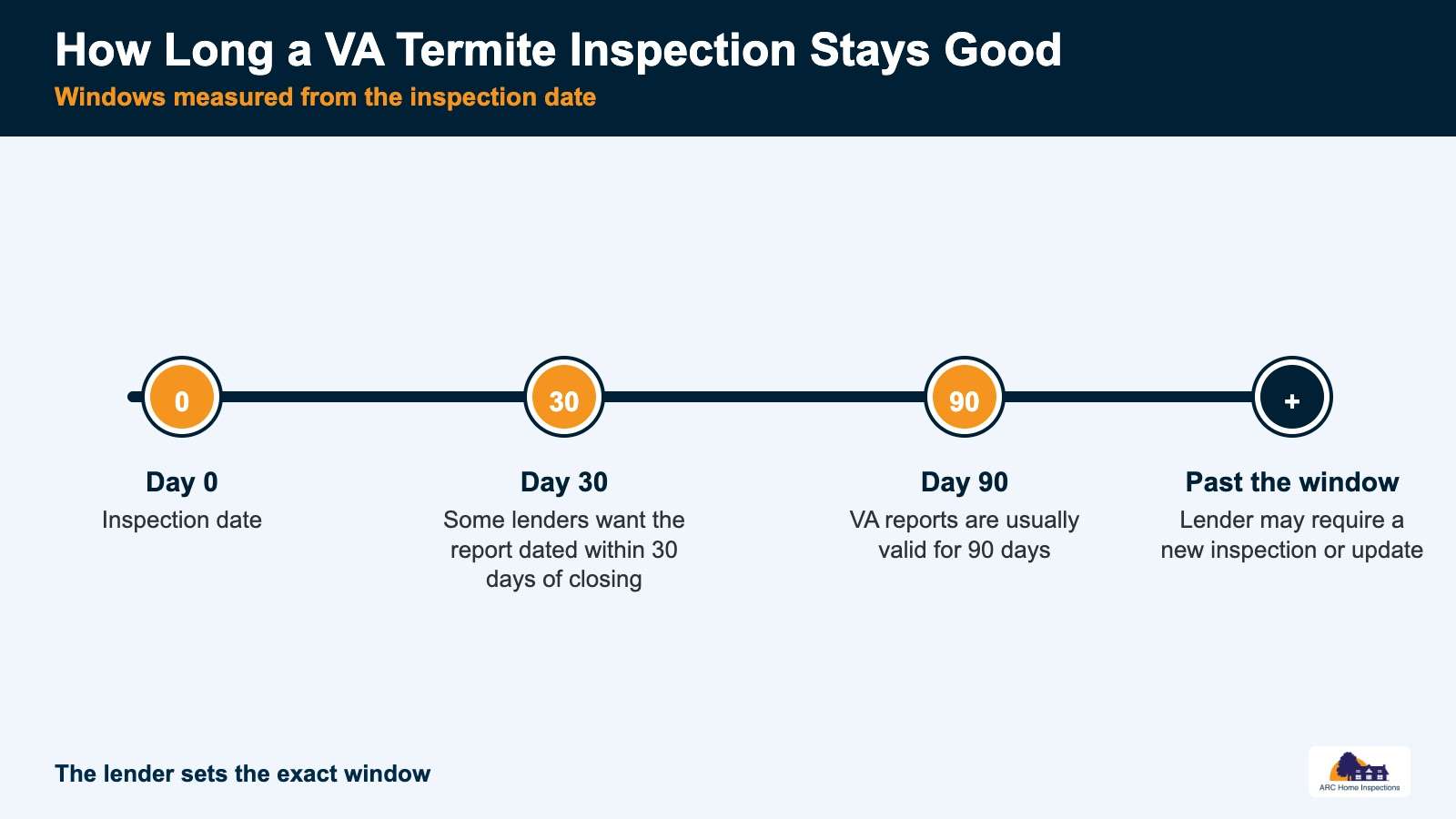
The graphic places the inspection on day 0 and the usual 90-day limit on day 90. The next question is which party decides the window on a given loan.
Who Sets the Validity Window on a Termite Inspection Report?
The lender sets the validity window on a termite inspection report, so each loan can carry a different deadline. Russell D. Smith, a mortgage lender, states that the length of time before a pest inspection expires varies between lenders. One pest company’s guide says lenders commonly set the window at 30 to 90 days before closing. The same guide lists Federal Housing Administration (FHA) loan windows of 30 to 60 days.
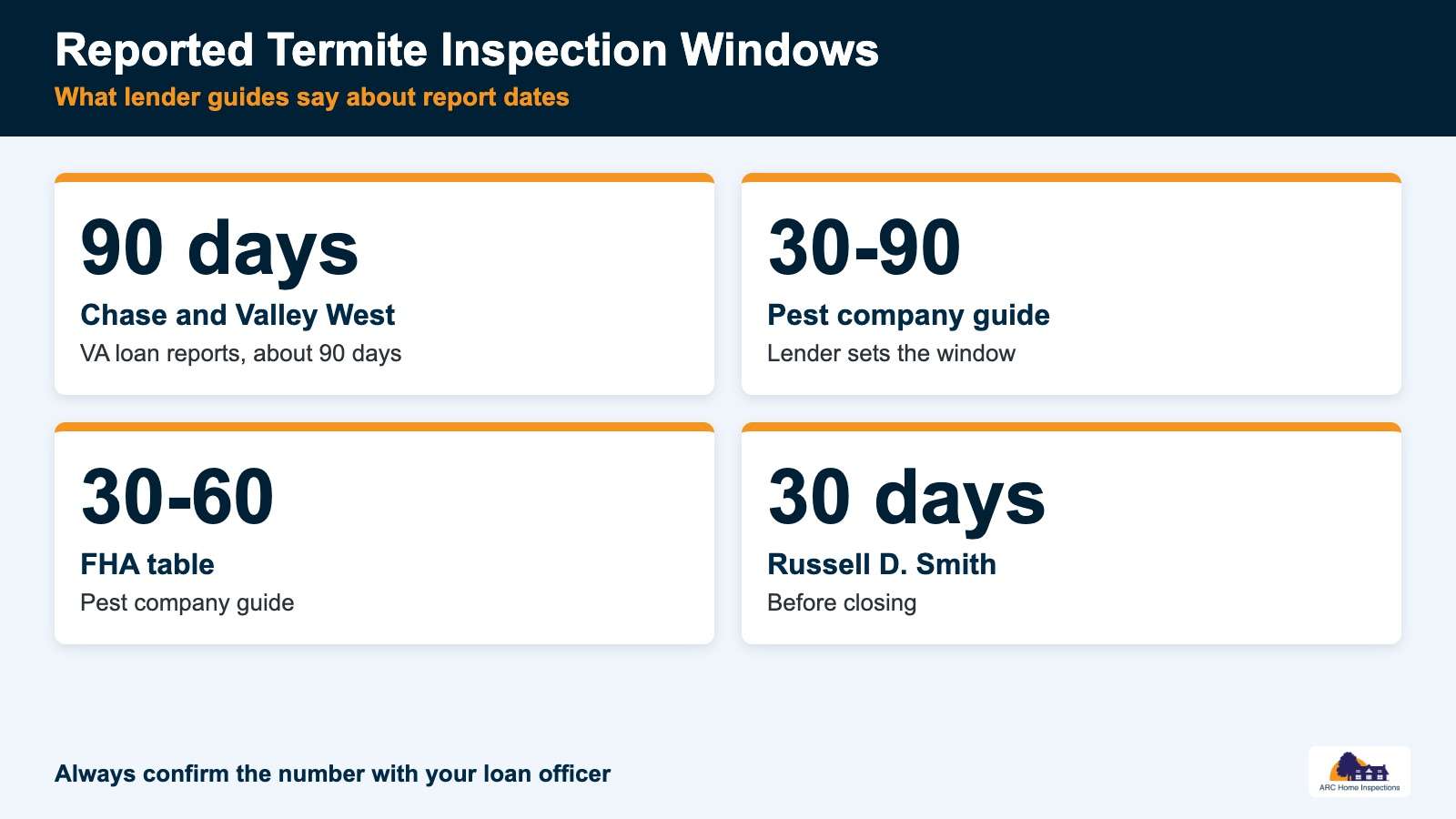
The table below compares the windows that these sources report.
| Source | Reported Window | Context |
|---|---|---|
| Chase | 90 days | VA loan reports |
| Valley West Mortgage | About 90 days | Order early in escrow |
| Pest company guide | 30 to 90 days | Lender sets the window |
| Pest company guide | 30 to 60 days | FHA table |
| Russell D. Smith | 30 days | Before closing |
These numbers differ because every lender writes its own rule, so the loan officer has the final word. Buyers can ask the loan officer for the exact number of days in writing. Scheduling a buyers inspection and the termite inspection close together keeps both report dates on one timeline.
The graphic below sets the reported windows side by side for a quick comparison.
What Does the VA Require for a Termite Inspection?
The VA requires a termite inspection when the Notice of Value calls for one. The Notice of Value is the VA’s appraisal result for the property. Valley West Mortgage reports that the VA requirement applies statewide in 29 states and the District of Columbia. It applies county by county in eight more states. The same lender lists Missouri as a statewide requirement.
Buyers can confirm the rule for a specific county with the lender before ordering. The rules for a VA loan termite inspection also cover payment, which the next section explains. A report that finds active wood-destroying insects needs treatment before a VA closing.
The inspection result drives what happens next in the loan process. A clean report lets the file move forward. A report with active insects sends the seller and the lender back to the schedule. Treatment adds days, so buyers benefit from an early inspection date.
We inspect and report on the property, and a licensed pest control company handles treatment. The report date then matters again once treatment finishes, because the closing date must still fall inside the lender’s window.
Who Pays for a VA Termite Inspection?
A veteran may pay for a VA termite inspection whenever the Notice of Value requires the inspection. A summary of VA Circular 26-22-11 reports that this change took effect on June 15, 2022. Veterans United says homebuyers should expect to pay around $100 to $200 for the inspection.
The purchase contract can still shift the cost to the seller through negotiation. Contract terms decide the buyer or seller split on other loan types. The payment question also connects to timing, because a report ordered late can force a second order.
What Happens When a Termite Inspection Report Expires Before Closing?
When a termite inspection report expires before closing, the lender may require a new inspection or an update. The answer to how long is a VA termite inspection good for depends on the closing date. The lender’s window runs from the inspection date, not from the contract date.
A report dated at the start of a long escrow can lapse before the keys change hands. A new report restarts the window, so the buyer then has a fresh set of days. Buyers should send the new report to the lender as soon as it arrives.
An update costs less time than a missed closing date. Asking the loan officer about an update before the window ends avoids a last-minute scramble. The lender needs a report that matches the closing file, and the buyer needs a report that reflects the home’s current condition. Both needs point to the same fix, which is a fresh inspection date.
Does a Seller’s Termite Report Stay Valid for a Buyer?
A seller’s termite report stays valid for a buyer only when the buyer’s lender accepts the report date. The lender decides the validity window, so an older seller report can fall outside it. Sellers who order a pre-listing inspection give buyers an early look at the home’s condition.
A report carries the date of its inspection, and that date starts the clock. A buyer whose lender needs a fresher date can order a new inspection for the contract timeline.
How Should You Time a Termite Inspection Around Closing?
Time a termite inspection around closing by working backward from the closing date and the lender’s window. Knowing how long is a VA termite inspection good for lets buyers work backward through the steps below.
- Ask the loan officer for the exact validity window in days.
- Count back from the closing date to find the earliest inspection date that still fits.
- Book the WDO inspection early in escrow, right after the offer is accepted.
- Send the finished report to the lender as soon as it arrives.
- Order an update when the closing date moves past the window.
Each step keeps the report date inside the lender’s window. We book a termite inspection around the closing timeline that the buyer shares with us. A closing date that never moves needs only the first four steps.
A short buffer between the inspection and closing protects the timeline. A report dated 60 days before closing leaves 30 days of room under a 90-day window. A report dated 10 days before closing leaves 80 days of room, which covers a long delay. A buffer also covers treatment time. A positive report sends the seller and a pest control company back to work before closing.
Does a Valid Termite Inspection Mean the Home Has No Termites?
No, a valid termite inspection does not mean the home has no termites after the inspection date. A termite inspection report describes visible, accessible areas on the day of the inspection. Chase notes that the 90-day window is not a promise that pests stay away before move-in.
The risk after the inspection is real. According to NPMA, termites cause an estimated $6.8 billion in property damage each year in the U.S. NPMA also reports that standard homeowners insurance policies almost universally exclude termite damage.
A Harris Poll for NPMA found that only 58% of U.S. homeowners are aware of the damage termites can cause. The same poll found that only 36% are familiar with common signs of infestation. Homeowners who learn the signs of termite damage can spot a problem before the next inspection.
How Often Should I Get a Termite Inspection?
A homeowner should get a termite inspection every 1 to 2 years. NPMA says a professional inspection every year is important. One pest control company reports that most pest specialists agree on an inspection every 1 to 2 years. NPMA spokesperson Jim Fredericks recommends the yearly schedule.
Homeowners who search how long is termite inspection good for outside a sale need a different answer than buyers do. The lender window does not apply to them. Their own schedule depends on the signs they see.
According to PestWorld, an NPMA site, termite swarms typically occur in early spring, and a swarm is often the first visible sign. NPMA survey data shows that fewer than half of homeowners, 45%, believe prevention is more cost-effective than repairing damage. A separate guide breaks down whether a yearly inspection is worth the cost for homeowners.
The checklist graphic below lists the events that call for a new inspection before the next scheduled one.
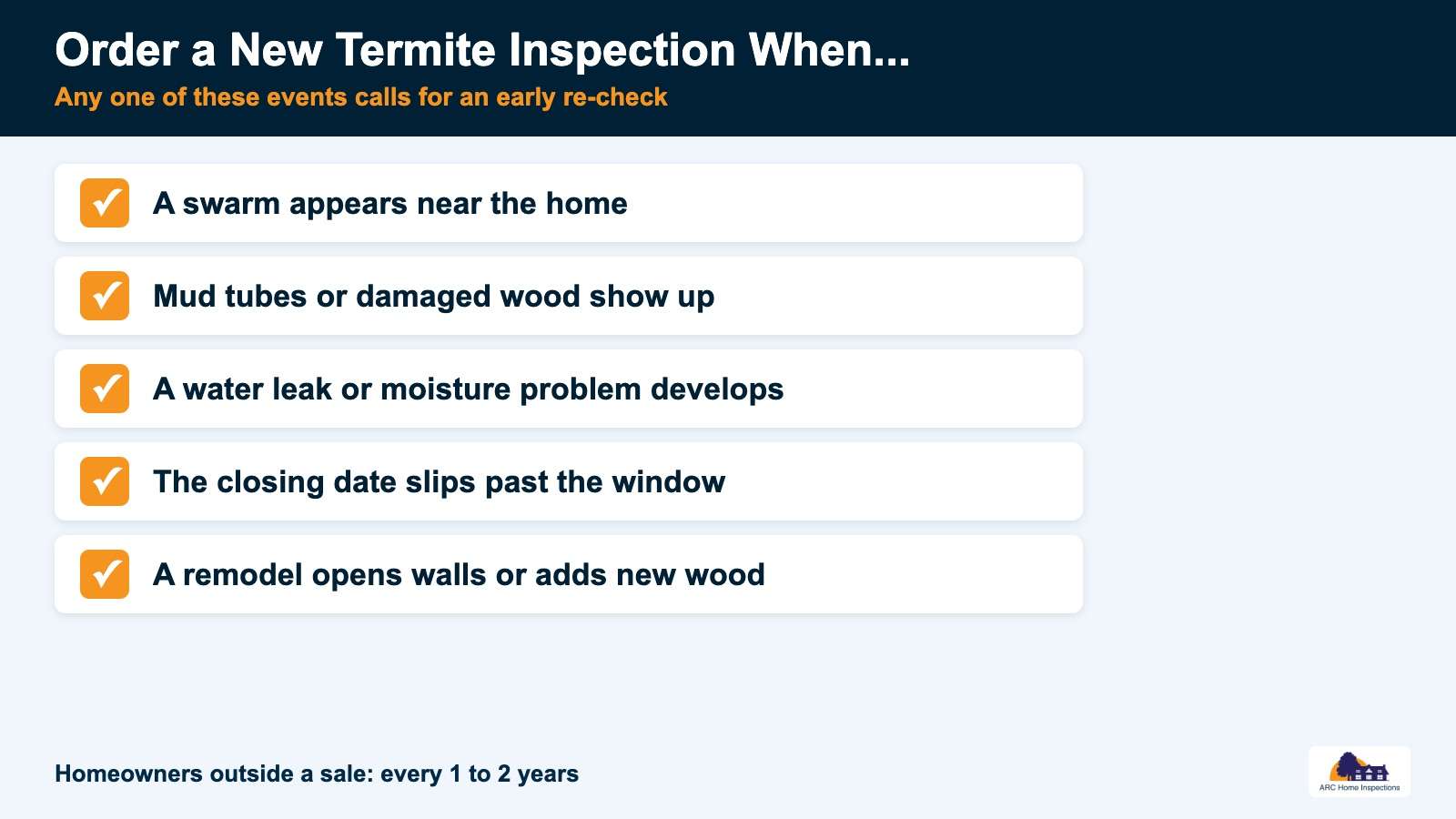
Order an early inspection when any of these events happen:
- A swarm appears near the home, especially in early spring.
- Mud tubes or damaged wood show up on a wall, post or foundation.
- A water leak or moisture problem develops.
- The closing date slips past the lender’s window.
- A remodel opens walls or adds new wood to the structure.
Who Can Perform a Termite Inspection for a Home Sale?
A licensed professional performs a termite inspection for a home sale, because state law requires a license. Section 281.116 of the Revised Statutes of Missouri (RSMo) sets the license rule, according to FindLaw. It requires anyone performing wood-destroying insect inspections in a real estate transaction to hold a valid Missouri certified commercial applicator license. The rule covers inspections requested by a buyer, seller or lender.
Buyers should confirm the inspector’s license before booking a termite inspection for home purchase paperwork. ARC performs a WDO inspection that checks for wood-destroying organisms such as termites. We inspect and report, and we do not treat.
What Else Should Buyers Know About Termite Inspections?
Buyers should know three more facts about termite inspections: the scope, the scheduling and the moisture link.
What Is a Wood-Destroying Insect Inspection?
A wood-destroying insect inspection is a visual check of a home for termites and other insects that damage wood. The inspector reports visible activity, visible damage and conditions that attract pests.
Can a Buyer Book a Termite Inspection With a Home Inspection?
A buyer can book a termite inspection with a home inspection by requesting both services for the same property. The two services are separate, so the buyer requests each one.
Why Does Moisture Matter During a Termite Inspection?
Moisture matters during a termite inspection because damp wood attracts termites and other wood-destroying insects. We also offer thermal imaging and moisture inspections to locate damp areas behind walls.
Frequently Asked Questions About Termite Inspection Timing
Frequently asked questions about termite inspection timing cover duration, cost, expiration and state rules.
How Long Do Termite Inspections Last?
Termite inspections last for the lender’s window, usually about 90 days on a VA loan. Homeowners outside a sale should repeat an inspection every 1 to 2 years. The report itself describes only the inspection day.
How Much Does a VA Termite Inspection Cost?
A VA termite inspection costs about $100 to $200, according to Veterans United. One pest company’s guide reports that inspections typically run $100 to $300 based on property size.
Does a Termite Inspection Expire?
A termite inspection expires when its date falls outside the lender’s window, which is usually about 90 days for a VA loan. A report that lapses before closing needs an update or a new inspection.
How Long Is a Termite Inspection Good for on an FHA Loan?
A termite inspection for an FHA loan is good for about 30 to 60 days, according to one pest company’s FHA table. The lender sets the final window, so the loan officer should confirm the number.
Is a Termite Inspection Required in Every State?
A termite inspection is not required in every state for a home sale. Valley West Mortgage reports that the VA requirement applies statewide in 29 states and the District of Columbia. It applies county by county in eight more states.
How Does ARC Home Inspections Help Buyers Time a Termite Inspection?
We help buyers time a termite inspection by scheduling the WDO inspection early in escrow. The early date leaves room for a closing delay inside the lender’s window.
Buyers who ask how long is a VA termite inspection good for get the same answer from us. The answer is about 90 days, with the lender setting the final date. We inspect and report on wood-destroying organisms, and licensed pest control companies handle treatment.
At ARC Home Inspections, we match the inspection date to the buyer’s closing timeline. Buyers can call (314) 948-3058 to set the date.