
Yes, you can get a home inspection before making an offer, but the seller must allow your inspector inside the home. A pre-offer inspection takes 2 to 4 hours, and the buyer pays the inspector even when no contract follows. Buyers usually inspect after the seller accepts an offer. An earlier report can strengthen a bid in a competitive market where buyers must decide fast.
Key Takeaways
- A buyer needs the seller’s permission before an inspector can enter the home.
- A pre-offer inspection takes 2 to 4 hours, and the report arrives within 24 to 48 hours.
- The buyer pays for the inspection, even when the offer is not accepted.
- Buyers usually inspect after acceptance, during the inspection contingency window.
- A clean pre-offer report can support a shorter contingency in a competitive market.
- A pre-offer report does not replace the inspection after acceptance when the contract keeps a contingency.
Can You Get a Home Inspection Before Making an Offer?
Yes, you can get a home inspection before making an offer, but only when the seller gives your inspector access. The seller has no duty to say yes, because the buyer is not under contract yet.
A pre-offer inspection is a standard buyers inspection moved earlier in the timeline. The inspector examines the same roof, structure, electrical, plumbing, and heating and cooling systems. The written report follows the same format.
Permission is the main hurdle. Realtor.com reports that agents describe seller permission as hard to obtain. One inspection firm says agents ask the listing agent for a 2 to 3 hour window, usually near a showing.
The buyer also pays the inspector, even when the offer fails. Buyers can compare that cost with the usual question of who pays for a home inspection. Timing matters just as much, because buyers usually schedule the inspection after an offer is accepted.
Does a Home Inspection Come Before or After an Offer?
A home inspection usually comes after the seller accepts an offer, during the inspection contingency window in the purchase contract. An inspection contingency is a contract clause that lets the buyer inspect the home, then negotiate or cancel based on the findings.
A pre-offer inspection reverses that order. The inspector visits first, and the buyer bids second. The table below shows the main difference, which is who controls access and who carries the payment risk.
| Factor | Pre-Offer Inspection | Inspection After Acceptance |
|---|---|---|
| Timing | Before the buyer submits an offer | After the seller accepts the offer |
| Access | Needs the seller’s permission | Granted through the contract’s inspection period |
| Payment risk | Buyer pays even if no contract follows | Buyer pays with a contract already in place |
| Contingency | Report can support a shorter contingency | Contingency lets the buyer negotiate or cancel |
The table shows why buyers usually wait, because access and payment risk both improve after acceptance. Buyers who ask can you get a home inspection before making an offer should plan for permission, payment and timing. Permission decides all three, so the next question is which homes allow an early inspection.
Can I Get a Home Inspection Before Making an Offer on Any Home?
You can get a home inspection before making an offer on a home when the seller approves the visit in advance. A seller can refuse, because an extra inspection disrupts showings and gives one buyer more time inside the property.
Your agent makes the request and names the date, the time window and who pays. NAR’s 2025 Profile found that 88% of buyers used an agent, so an agent usually makes the request. The same report shows first-time buyers fell to 21% of buyers, with a median age of 40.
Some sellers already hold a report. A seller who orders a pre-listing inspection can share the findings before any offer arrives. Chase still advises buyers to order an independent inspection for an unbiased view.
Once the seller approves the visit, the pre-offer inspection runs in a set order.
How Does a Pre-Offer Inspection Work?
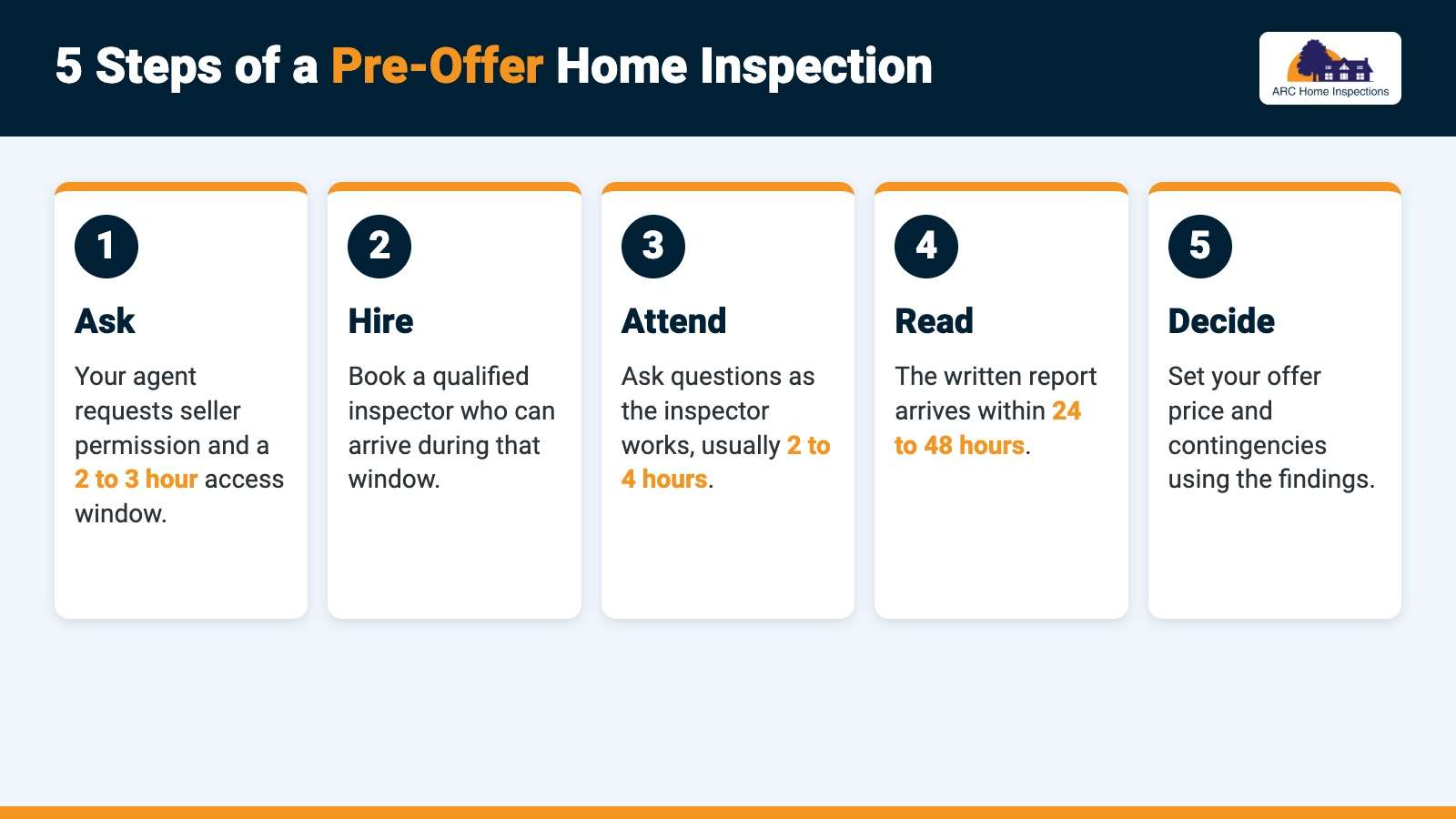
A pre-offer inspection works in five steps, from seller approval to a final offer decision. Each step builds on the step before it.
- Ask your agent to request seller permission and a 2 to 3 hour access window.
- Hire a qualified inspector who can arrive during that window.
- Attend the inspection and ask questions as the inspector works.
- Read the written report, which arrives within 24 to 48 hours.
- Set your offer price and contingencies using the findings.
The graphic below shows the same five steps in order.
The inspection itself is visual. According to ASHI, an inspector examines readily accessible, visually observable installed systems. ASHI also states that an inspection is not a warranty and does not predict future failure. A pre-offer inspection therefore describes the home’s condition on the visit day only.
That limited scope shapes how long the visit takes and what it costs.
How Long Does a Pre-Offer Inspection Take and What Does It Cost?
A pre-offer inspection takes 2 to 4 hours for a single-family home, according to ASHI. Larger and older homes take longer, because the inspector has more systems and rooms to examine.
The cost matches a standard pre purchase inspection. Chase reports that a pre-sale inspection typically costs the same as one under contract, between $296 and $424. Square footage, age and add-on tests change the final price.
Add-on tests raise the total. Chase lists radon testing, mold inspection, septic assessments and well assessments as common extras. Each extra adds time at the property.
The report arrives within 24 to 48 hours in many cases, according to ASHI. One inspection firm reports delivery within 24 hours. Offer deadlines in a busy market can be shorter than that window, so agents book the inspector early.
Time and money lead to the value question, which is whether a pre-offer inspection is worth it.
Is a Pre-Offer Inspection Worth It?
A pre-offer inspection is worth it when competition pushes buyers to shorten or waive the inspection contingency. Chase reports that some buyers in competitive markets use pre-inspections to waive contingencies and make their offers more attractive.
Waiving a contingency removes the buyer’s right to cancel over the findings. One inspection firm advises buyers to talk with an agent and an attorney first. NAR’s 2025 Profile found that 26% of buyers paid all cash, and cash offers set the pace in many bidding contests.
A pre-offer inspection delivers three benefits:
- Competitive offers: the report supports a shorter inspection contingency.
- Budget clarity: repair costs can be priced into the offer.
- Fixer-upper scope: the buyer sees the full repair list before bidding.
The main drawback is cost. Realtor.com notes that the buyer pays before the price, closing date and contingencies are settled. Chase adds that a buyer’s market, where time allows a standard inspection, reduces the value of an early inspection.
The graphic below compares when a pre-offer inspection pays off and when waiting makes sense.
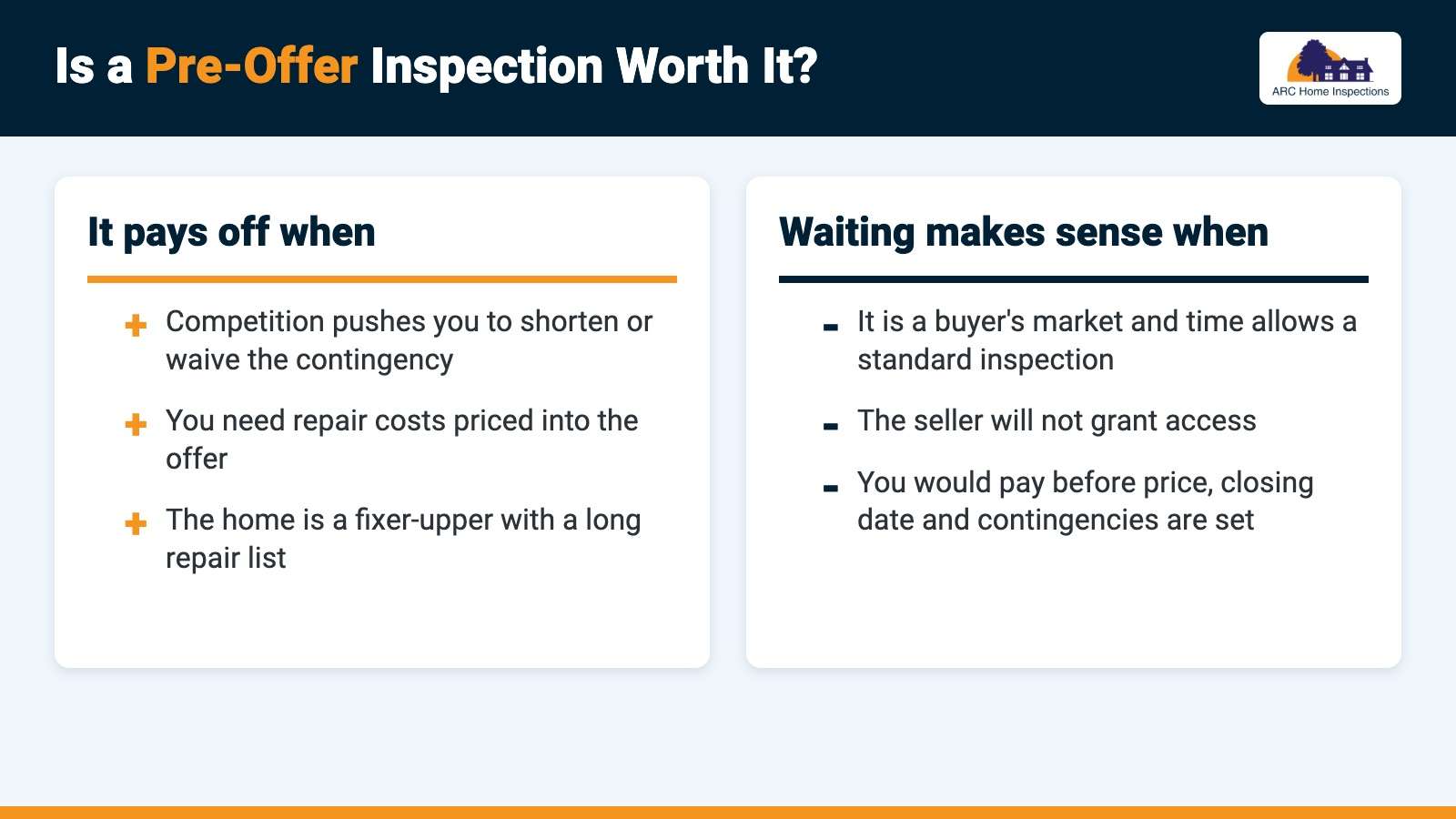
The comparison shows that the answer depends on the buyer, which leads to the question of whether you should get one.
Should I Get a Home Inspection Before Making an Offer?
You should get a home inspection before making an offer when the market is competitive or repair risks are hidden. A quick showing cannot settle radon levels, termite damage, wiring or plumbing.
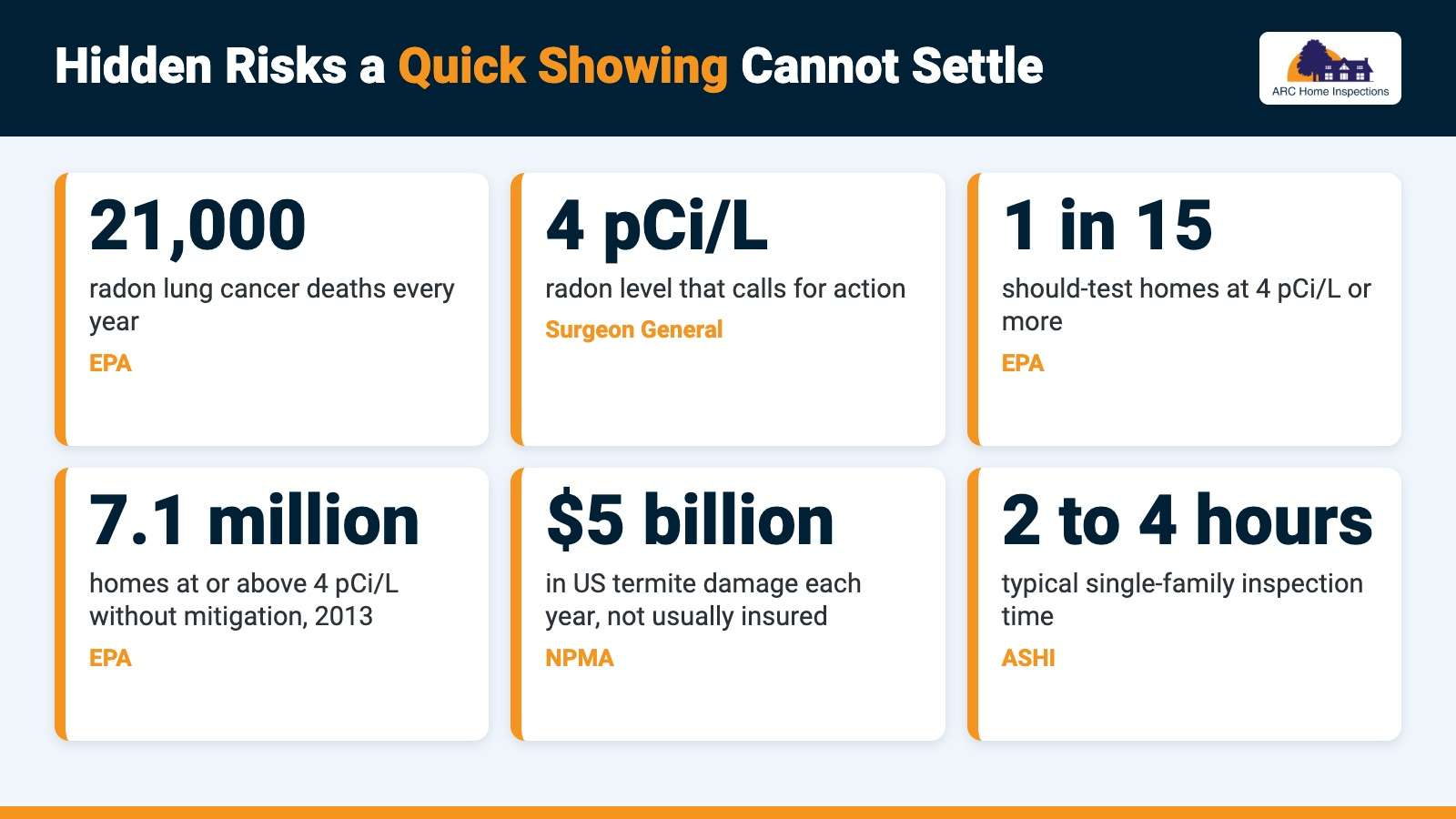
Radon is a hidden risk that only a test can measure. According to the EPA, radon causes about 21,000 lung cancer deaths every year, including about 2,900 in people who never smoked. The EPA ranks radon first among causes of lung cancer in nonsmokers. The Surgeon General urges action at 4 picocuries per liter (pCi/L) or more, and radon testing measures that level.
The EPA reports that about 1 in 15 homes in its should-test category has radon at 4 pCi/L or more. Homes at or above that level without a mitigation system rose from about 6.2 million in 1990 to 7.1 million in 2013.
Termites are the second hidden risk. The National Pest Management Association says termites cause more than $5 billion in US property damage each year. Homeowners insurance typically does not cover that damage. A termite inspection checks the home for wood-destroying insects before the buyer commits to a price.
Homes outside city limits can add a private sewage system that a showing cannot evaluate. A septic system inspection covers the tank, the drain field and the working condition of that system before the offer.
Private wells add a water supply risk that a showing also cannot evaluate. For the same reason, a buyer can request well water testing before bidding.
The graphic below pulls the key figures together.
Even a strong pre-offer report has limits, which raises the question of whether it replaces the inspection after acceptance.
Does a Pre-Offer Inspection Replace the Inspection After Acceptance?
A pre-offer inspection does not replace the inspection after acceptance when the buyer keeps an inspection contingency in the contract. The contingency protects the buyer’s right to negotiate or cancel after a second look.
A clean pre-offer report lets a buyer shorten that window, but the report describes only the visit day. Conditions can change before closing, and an inspection under contract can reveal new defects. Buyers should also confirm the contract’s response deadline after each report. Each deadline appears in the signed agreement, so the buyer should read it before the report arrives.
Inspection findings give the buyer documented items to raise with the seller. Buyers who find defects can still negotiate repairs once the contract is signed. Those repair requests rely on the written report, so a complete report matters.
Visual limits also apply. A home inspector cannot see inside walls, under finished floors or behind locked doors, so inaccessible areas stay unchecked.
A lender appraisal does not fill that gap. ASHI states that a home inspection is not an appraisal and does not determine market value. HUD’s FHA notice says appraisals differ from home inspections and that FHA makes no promise about a home’s value or condition. ASHI also notes that VA loans require a hybrid appraisal and inspection that may be less detailed than other inspections. The two documents are compared in detail under inspection versus appraisal.
These limits raise a few more buyer questions, which the next section answers.
What Else Should Buyers Know About Inspecting Before an Offer?
Buyers should know that inspecting before an offer puts the report, contract terms and safety findings ahead of the price. The short answers below cover the questions buyers ask next.
What Is the Biggest Red Flag in a Home Inspection?
The biggest red flag in a home inspection is a defect that threatens safety or structure. Examples include active water intrusion, foundation movement, faulty wiring and high radon. Radon at 4 pCi/L or more calls for action under the Surgeon General’s advisory.
Do Inspectors Flush Toilets During a Home Inspection?
Inspectors flush toilets during a home inspection to check flow, drainage and leaks. Inspectors also run faucets and showers for the same reasons.
What Safety Hazards Can a Quick Showing Miss?
A quick showing misses safety hazards such as carbon monoxide problems, which no walkthrough can detect by sight. The CDC reports that more than 400 Americans die each year from unintentional non-fire carbon monoxide poisoning. More than 100,000 visit emergency rooms, and more than 14,000 are hospitalized. The CPSC adds that more than 200 deaths a year trace to consumer products. Alarms belong on every level.
Does a Pre-Offer Inspection Report Help You Negotiate?
A pre-offer inspection report helps you negotiate because it lists documented defects that the buyer can price into the offer. Chase notes that buyers use the findings to forecast the budget more accurately.
Frequently Asked Questions About Inspections Before an Offer
Frequently asked questions about inspections before an offer cover earnest money, competition, cost, and the seller’s report.
Do You Lose Earnest Money If an Inspection Fails?
Whether a buyer loses earnest money after a failed inspection depends on the contract’s contingency terms. The purchase contract sets the deadline and the conditions for cancelling, so confirm both with your agent. Earnest money is the deposit that shows the buyer’s good faith.
Can You Do a Home Inspection Before Making an Offer in a Competitive Market?
You can do a home inspection before making an offer in a competitive market when the seller approves access. Speed matters, so agents book an inspector who can work within a 2 to 3 hour window. A clean report may then support a shorter contingency.
What Two Steps Should You Take Before You Make an Offer?
Take two steps before you make an offer: get a mortgage preapproval and review recent comparable sales with your agent. Preapproval confirms your budget, and comparable sales confirm a fair price. Together they set the limits for any offer.
How Much Does a House Inspector Typically Cost?
A house inspector typically costs $296 to $424, according to Chase. Home size, age and add-on tests such as radon change the final price.
Is a Lender Appraisal the Same as a Home Inspection?
A lender appraisal is not the same as a home inspection, because an appraisal estimates value while an inspection reports condition. ASHI notes that an inspection does not determine market value. Buyers need both documents for different reasons.
Do Buyers Still Need an Inspection If the Seller Has a Report?
Buyers still need their own inspection when the seller already has a report, because an independent inspector gives an unbiased evaluation. Chase says the lender may also require one. The seller’s report still helps buyers judge the home before offering.
How Does ARC Home Inspections Help Buyers Before an Offer?
We help buyers before an offer by scheduling the inspector around the access window the seller allows and delivering a written report. Our home inspection for buyers covers the same systems whether the visit happens before or after an offer.
Buyers across Missouri can add radon, mold, termite, well water and septic checks to the same visit. Alan Redburn, an InterNACHI certified professional inspector, owns ARC Home Inspections.
The answer to can you get a home inspection before making an offer is yes. We schedule the visit once the seller grants access. Call us at (314) 948-3058 to book a time.