Ask your home inspector what the inspection covers, how old the major systems are, and which findings are safety hazards. Buyers get more from the visit with a plan. Knowing what to ask at home inspection time turns a 2 to 4 hour visit into a clear repair plan. Questions about specialists, maintenance and add-on tests finish the job, and each one gets a clear answer below.
Key Takeaways
- A home inspection is visual, is not an appraisal and does not verify code compliance, according to ASHI.
- Plan for 2 to 4 hours on site and a written report within 24 to 48 hours, per ASHI.
- Ask whether each finding is a safety hazard, a major defect or routine maintenance before the inspector leaves.
- Request separate tests for radon, mold, wells, septic systems and termites, because a standard inspection does not test for them.
- The EPA says radon causes about 21,000 lung cancer deaths a year and urges action at 4 pCi/L or more.
- Keep questions factual: ask about condition and safety, not market value, code or repair prices.
What Should You Ask at a Home Inspection?
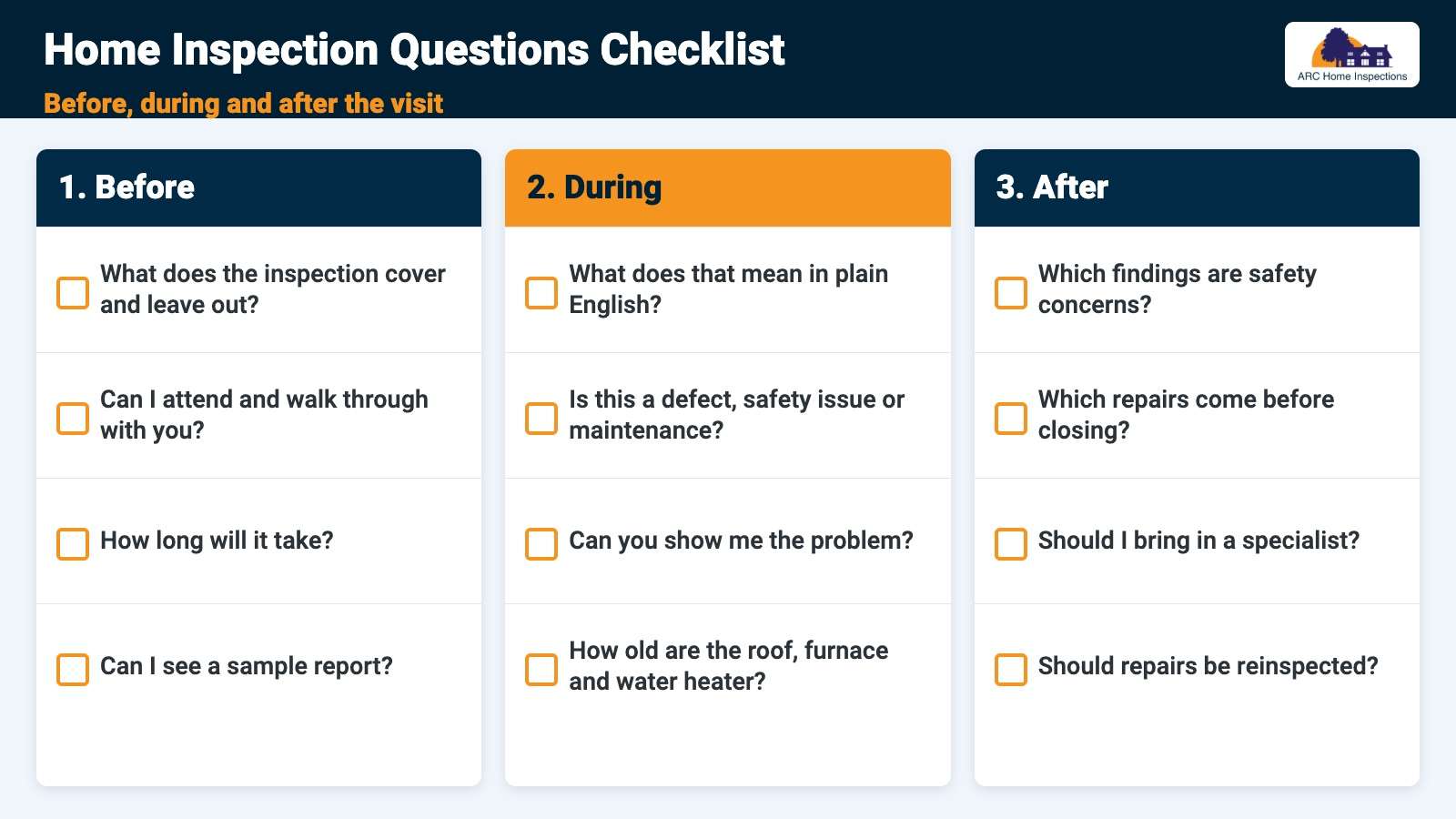
You should ask a home inspector what the inspection covers, how old the major systems are, and which safety issues exist. Those questions fall into three phases: before the visit, during the walk-through, and after the report. Buyers who know what to ask at home inspection time can use every phase.
A buyers inspection gives the clearest answers when the buyer attends and asks on site. According to ASHI, a home inspection is a visual review. It is not an appraisal and does not verify code compliance. That scope shapes every question in this guide: ask about condition, safety and maintenance, and leave value and code to other professionals.
NAR data shows first-time buyers made up 21% of buyers in its 2025 profile, and the median first-time buyer was 40. The checklist card below puts the key questions from each phase on one page.
What Are the Most Important Questions to Ask a Home Inspector?
The most important questions to ask a home inspector sort every finding into safety hazard, major defect or routine maintenance. Five questions do that sorting for any house, in any condition. Ask these five on every inspection:
- Ask what each finding means in plain English.
- Ask whether each finding is a safety hazard, a major defect or routine maintenance.
- Ask how old the roof, furnace, air conditioner and water heater are.
- Ask which systems need a specialist, such as a roofer, plumber or electrician.
- Ask which repairs or maintenance tasks to handle in the first year.
These five questions apply to every house, and the tables later add detail for each system.
Should You Walk Around With Your Home Inspector?
You should walk around with your home inspector, because attending lets you ask questions and see each finding in person. Realtor.com notes that attending gives you clear explanations and maintenance guidance on site. Buyers, agents and sometimes sellers have different roles, as the breakdown of who should attend a home inspection explains.
ASHI says a single-family inspection usually takes 2 to 4 hours, so plan the whole window. NAR’s 2025 Profile found that 88% of buyers used an agent, so ask your agent to confirm access and timing. Use these five steps on inspection day:
- Arrive at the start so you can meet the inspector and confirm the scope.
- Follow the inspector outside first, then through the interior, attic and crawl space.
- Ask each question when the inspector is standing at that system.
- Photograph and write down every finding as the inspector explains it.
- Ask your closing questions before the inspector leaves the property.
The next section covers the questions to settle before that day arrives.
What Questions Should You Ask Before the Home Inspection?
You should ask seven questions before the home inspection: scope, experience, credentials, attendance, duration, report format and add-on tests. Realtor.com puts a typical inspection fee at $300 to $600. Chase cites $296 to $424, so confirm the fee when you book. Write down what to ask in home inspection prep, then bring the list on inspection day.
| Question to Ask | What It Tells You |
|---|---|
| What does the inspection cover, and what does it leave out? | Sets the scope and shows which systems need a separate test. |
| How long have you been inspecting, and how many homes have you inspected? | Shows experience with homes of this age and type. |
| What certifications and training do you hold? | Confirms professional credentials and continuing education. |
| Can I attend and walk through the home with you? | Confirms you can ask questions on site. |
| How long will the inspection take? | Sets your schedule. ASHI says 2 to 4 hours is usual. |
| Can I see a sample report? | Shows how clearly findings, photos and priorities are written. |
| Do you offer radon, mold, well water, septic or termite testing at the same visit? | Avoids a second appointment for add-on tests. |
Once the inspector agrees to the scope, the on-site questions begin.
What Questions Should You Ask During the Home Inspection?
You should ask eight core questions during the home inspection, starting with what each finding means. These are the questions to ask during a home inspection at every system, from the roof to the basement.
| Question to Ask | What It Tells You |
|---|---|
| What does that mean in plain English? | Turns inspection language into something you can act on. |
| Is this a major defect, a safety issue or routine maintenance? | Sorts the finding so you know what matters. |
| Can you show me exactly where the problem is? | Lets you see the defect instead of reading about it later. |
| What caused this water stain, crack or damage? | Separates an old, settled problem from an active one. |
| How do I maintain this system after I move in? | Gives maintenance steps for the furnace, panel, basement or roof. |
| Where are the main water shut-off, gas shut-off and electrical panel? | Prepares you for an emergency on the first day. |
| What worries you most about this house? | Surfaces the inspector’s top concern in one answer. |
| Would you want a specialist to look at this? | Flags items that need more than a visual inspection. |
Questions that ask the inspector to show the problem get the clearest answers. Each system then adds its own questions, starting with the roof, foundation and exterior.
What Questions Should You Ask About the Roof, Foundation and Exterior?
Questions about the roof, foundation and exterior should cover age, condition and water flow, because water harms each area. According to Homebase Credit Union, a good roof should last 20 to 25 years, depending on climate and materials.
| Area | Question to Ask | What It Reveals |
|---|---|---|
| Roof | How old is the roof, and how many years does it have left? | Shows when replacement may be due. |
| Roof | What condition are the shingles, flashing and vents in? | Finds wear, damage and leak points. |
| Foundation | Are these cracks normal settling or signs of movement? | Separates cosmetic cracks from structural ones. |
| Grading | Does the ground slope away from the house? | Shows whether rain drains away from the foundation. |
| Gutters | Do the gutters and downspouts carry water well away from the walls? | Finds a common source of basement moisture. |
| Attic | Is the insulation and ventilation adequate? | Flags heat loss and moisture buildup. |
| Crawl space | Do you see moisture, pests or damage under the house? | Reveals hidden water and wood problems. |
| Deck and porch | Are the framing, railings and stairs secure and sound? | Finds rot, loose connections and fall risks. |
Water and wiring come next, because plumbing, electrical and HVAC findings can follow a roof or grading problem.
What Questions Should You Ask About Plumbing, Electrical and HVAC?
Questions about plumbing, electrical and HVAC systems should cover age, condition and safety, because failures in these systems disrupt daily life. HVAC stands for heating, ventilation and air conditioning. Ask each question at the system itself, such as the panel, the furnace or the water heater.
| System | Question to Ask | What It Reveals |
|---|---|---|
| Plumbing | Do you see active leaks, corrosion or past repairs? | Finds current water damage and patched problems. |
| Plumbing | What are the supply pipes made of, and is any lead or galvanized steel present? | Identifies aging or hazardous pipe materials. |
| Plumbing | How are the water pressure and drainage? | Finds weak flow and slow drains. |
| Water heater | How old is the water heater, and what condition is it in? | Shows when replacement may be due. |
| Electrical | Is the panel sized correctly and free of safety defects? | Flags overloaded or unsafe panels. |
| Electrical | Do you see signs of amateur wiring? | Finds unsafe do-it-yourself work. |
| Electrical | Are ground-fault outlets installed in kitchens, baths and outdoors? | Checks shock protection near water. |
| HVAC | How old are the furnace and air conditioner, and were they serviced? | Shows remaining life and upkeep. |
| HVAC | Does the system heat and cool every room evenly? | Finds weak airflow or undersized equipment. |
System age and condition explain much of a home’s future cost. Safety questions deserve their own section, because some answers cannot wait for a repair schedule.
What Questions Should You Ask About Safety Hazards?
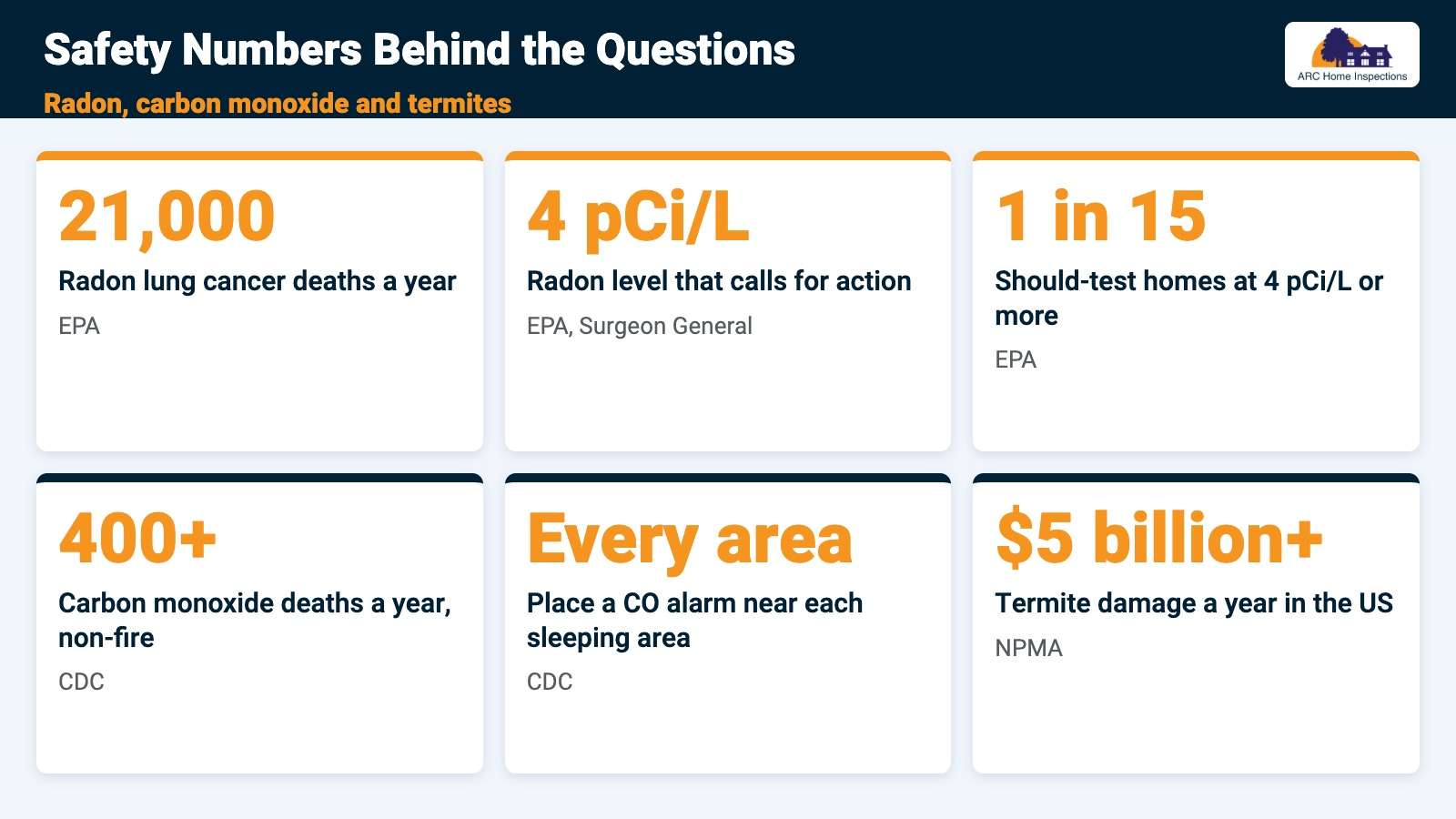
Questions about safety hazards should cover smoke and carbon monoxide alarms, wiring, railings, radon and mold. According to the CDC, more than 400 Americans die each year from unintentional non-fire carbon monoxide poisoning. The same source counts more than 100,000 emergency room visits and more than 14,000 hospitalizations yearly. It recommends an alarm near every sleeping area.
| Question to Ask | Why It Matters |
|---|---|
| Are smoke and carbon monoxide alarms present, placed correctly and working? | Alarms give early warning of fire and gas. |
| Do the stairs, decks and railings meet basic safety expectations? | Loose or missing railings cause falls. |
| Do you see signs of unsafe wiring, double-tapped breakers or scorched outlets? | Electrical defects can start fires. |
| Do you see signs of mold, asbestos or lead paint that call for specialized testing? | Some hazards need lab testing, not a visual check. |
| Should I test this home for radon? | The EPA urges action at 4 pCi/L or more. |
| Do you see signs of termites or other wood-destroying insects? | Hidden damage can be costly and is typically not covered by insurance. |
The CPSC reports more than 200 deaths a year from carbon monoxide tied to consumer products. It adds that alarms belong on every level of the home and outside sleeping areas. The numbers below show why these safety questions earn their place on the list.
What Is the Biggest Red Flag in a Home Inspection?
The biggest red flag in a home inspection is a safety hazard or structural defect. Examples include active foundation movement, water intrusion and unsafe wiring. The same logic appears in this breakdown of inspection red flags.
Ask whether the damage is still active, and ask what caused it. An old, stable crack and an active leak call for very different responses. Your answers decide whether a problem is a repair request or a reason to reconsider the purchase.
Which Questions Lead to Radon, Mold, Well, Septic and Termite Tests?
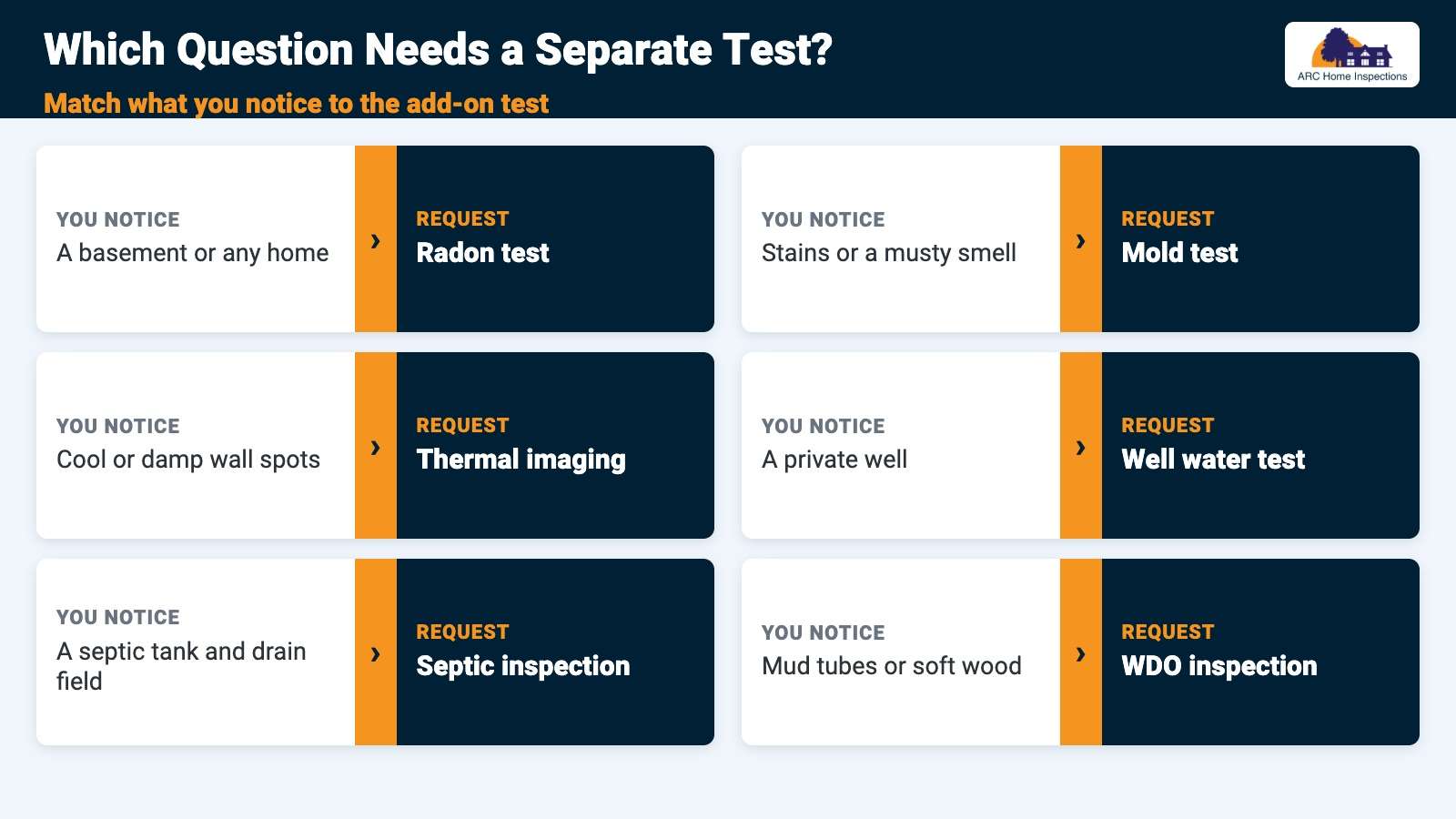
Questions about radon, mold, wells, septic systems and termites lead to separate tests that a standard home inspection does not include. The table matches what you notice to the question and the test.
| What You Notice | Question to Ask | Test to Request |
|---|---|---|
| Any home, especially one with a basement | Should I test for radon before closing? | Radon test |
| Stains, musty smell or past leaks | Does this need mold testing? | Mold test |
| Cool or damp spots on walls or ceilings | Can thermal imaging show hidden moisture? | Thermal imaging and moisture inspection |
| Private well supply | Is the water safe to drink? | Well water test |
| Septic tank and drain field | What condition is the septic system in? | Septic system inspection |
| Mud tubes, soft wood or past treatment | Is there active termite damage? | WDO inspection |
According to the EPA, radon causes about 21,000 lung cancer deaths every year, including about 2,900 among people who never smoked. EPA data shows about 1 in 15 homes in its “should test” group has 4 picocuries per liter (pCi/L) or more. Ask the inspector to arrange radon testing before closing. The EPA estimates 7.1 million homes at or above 4 pCi/L had no mitigation system in 2013. Ask what a reading at that level would require.
Visible staining or a musty smell raises the mold question. Mold can grow wherever moisture lingers, so ask where the inspector saw dampness. A lab-backed mold testing visit confirms whether mold is present and where it is growing. Results guide the next step.
Hidden moisture is harder to spot than visible staining, and moisture feeds mold. Thermal imaging inspections can show wet areas behind finished surfaces, which lets you ask targeted questions about the cause of the moisture.
Rural homes add two more systems. A private water supply needs well water testing for bacteria and other contaminants. Taste alone cannot confirm that water is safe. Results arrive from a lab.
A home with a tank and drain field needs a septic system inspection. Nobody can judge buried components from the yard.
Termites complete the list. According to NPMA, termites cause more than $5 billion in property damage each year in the US. A WDO termite inspection checks for wood-destroying organisms, and homeowners insurance typically does not cover termite damage.
What Questions Should You Ask After the Home Inspection Report?
You should ask which findings need repair before closing and which need a specialist after the home inspection report arrives. ASHI says reports usually arrive 24 to 48 hours after the visit. According to Redfin, reports commonly include dozens of findings, so priorities matter.
| Question to Ask | Why It Matters |
|---|---|
| Which findings are immediate safety concerns? | Puts urgent items first. |
| Are these cosmetic issues or signs of a bigger problem? | Separates paint-level issues from hidden damage. |
| Which repairs should I prioritize before closing? | Builds a short, defensible repair request. |
| What caused this issue? | Shows whether a repair fixes the root problem. |
| Will any finding affect my homeowners insurance? | Flags items that can change coverage or cost. |
| Should I bring in a specialist? | Sends structural, electrical or roofing items to the right trade. |
| Who should provide an estimate for these repairs? | Redfin advises written estimates from qualified contractors. |
| Which items are routine maintenance and which are deferred maintenance? | Separates upkeep from neglected repairs. |
| Should repaired items be reinspected? | Confirms the work was completed correctly. |
Use the answers to negotiate repairs with facts instead of guesses. Written estimates from contractors give your repair request real numbers to work from. Those numbers also help the seller see why each request is reasonable.
The inspection report guide for first-time buyers explains the document, including how inspectors sort and rate each finding.
Agreed repairs belong in writing, and the buyer keeps that record for closing. After the seller completes those repairs, a re-inspection confirms the work.
What Should You Not Ask a Home Inspector?
You should not ask a home inspector about market value, code compliance, future failures or repair prices. ASHI states that an inspection is not an appraisal, does not verify code compliance and does not predict future failure. Redirect each of these questions to the right professional.
| Question to Skip | Why It Does Not Fit | Ask Instead |
|---|---|---|
| What is the house worth? | An inspection is not an appraisal. | Ask your agent or the appraiser. |
| Does the house meet current code? | An inspection does not verify code compliance. | Ask the local building department. |
| When will this system fail? | An inspection does not predict future failure. | Ask how old the system is and what condition it is in. |
| How much will the repair cost? | Inspectors report condition, not bids. | Ask for written estimates from contractors. |
| Should I buy this house? | The decision depends on your budget and risk. | Ask which findings affect your decision. |
The limits go further, as the guide on what an inspector cannot see or access shows. Knowing the limits keeps every question useful.
What Else Should Buyers Know About Home Inspection Questions?
Buyers should know a few practical details about home inspection questions before inspection day.
Do They Flush Toilets During a Home Inspection?
Yes, inspectors flush toilets and run water during a home inspection to check flow, drainage and leaks.
How Long Does a Home Inspection Take?
A home inspection takes 2 to 4 hours for a single-family home, according to ASHI.
What Should You Bring to a Home Inspection?
Bring a notebook or phone, your written question list and the listing details to a home inspection. Confirm that utilities are on and that the attic, panel and water heater are accessible.
FAQs About What to Ask at a Home Inspection
These FAQs cover what to ask at a home inspection beyond the system tables above.
What to Watch Out for During a Home Inspection?
What to watch out for during a home inspection includes water stains, cracks, musty smells and unsafe wiring. Watch where the inspector spends extra time, because that signals a concern. Ask about each one before moving on.
What Is the Worst Thing a Home Inspector Can Find?
The worst thing a home inspector can find is a structural or safety defect. Examples include active foundation movement, major water intrusion and unsafe electrical or gas systems. These findings can affect safety and financing. Ask what caused them and which specialist should evaluate them.
Are Home Inspectors Picky?
Home inspectors are thorough by design, because the report must document every visible defect. Reports commonly list dozens of items, according to Redfin. Ask the inspector to separate cosmetic items from real concerns.
What Are Some Good Questions to Ask a Home Inspector?
Good questions to ask a home inspector are what the inspection covers and which findings are safety issues. Add questions about maintenance and specialists. Ask for a sample report before you book.
What Is the First Thing an Inspector Wants to See?
The first thing an inspector wants to see is clear access to the exterior, panel, attic and water heater. Buyers can help by confirming utilities are on.
How Does ARC Home Inspections Help Buyers Ask the Right Questions?
ARC Home Inspections helps buyers ask the right questions by explaining each finding on site and in a written report. We serve buyers across Missouri with buyers inspections, radon, mold, well, septic and termite testing. Alan Redburn, a certified professional inspector, leads every inspection. We explain findings in plain English, so buyers leave with answers.
Bring this question list to your visit, and we will walk you through each answer.
Buyers can reach ARC Home Inspections to book an inspection. Knowing what to ask at home inspection time lets you use the full visit. Our inspectors answer these questions on site, and the written report records each finding.
Call (314) 948-3058 to schedule a buyer’s inspection.