
No, a home inspection is not part of closing costs in a typical purchase. The buyer pays the inspector directly, usually $300 to $500 according to Redfin, on the day of the inspection. Closing costs cover loan and transaction fees, not optional condition checks. A fee reaches the closing table only through a seller credit or a rare pay-at-close arrangement.
Key Takeaways
- A home inspection is paid directly to the inspector, not through the closing disclosure.
- A standard inspection costs $300 to $500, and add-on tests cost extra.
- The appraisal is a lender requirement, while the inspection is buyer due diligence.
- A seller credit can offset the fee at closing, but the contract must say so.
- Budget the inspection fee as cash due before closing day.
Is Home Inspection Included in Closing Costs?
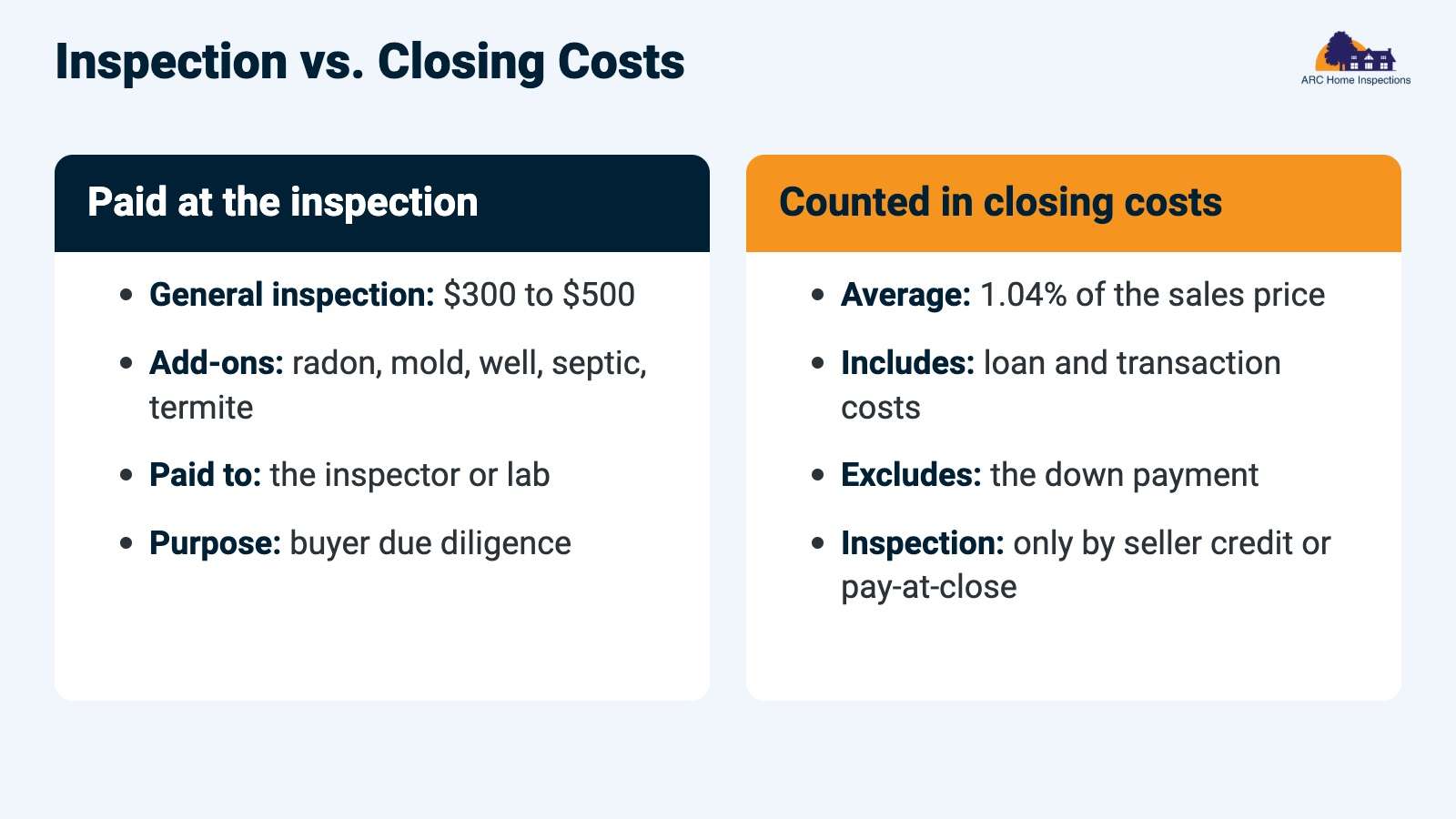
A home inspection is usually not included in closing costs. The buyer pays the inspector directly, and that payment happens before closing day.
Redfin states that the cost is paid out of pocket at the time of the inspection. The fee is not included in closing costs. The National Association of Realtors (NAR) consumer guide adds that buyers are typically responsible for inspection costs. A buyer’s inspection therefore arrives as its own invoice, separate from the lender and title charges.
The answer to “is home inspection included in closing costs” is no for a typical purchase. The reason becomes clear once the definition of closing costs is on the table.
What Counts as Closing Costs on a Home Purchase?
Closing costs on a home purchase are the upfront loan and transaction costs, excluding the down payment. The Consumer Financial Protection Bureau (CFPB) uses that definition, and its closing disclosure guidance does not name the inspection.
Lender fees, title charges and recording fees make up the bulk of these costs. Each one belongs to the loan or the legal transfer of the property. A home inspection belongs to neither, because the inspector works for the buyer.
The size of these costs is easy to measure. National Mortgage News reported LodeStar Software data showing that purchase closing costs averaged 1.04% of the sales price in 2025. That figure equals $4,528 on a median price of $433,632. Closing costs ran from 39 basis points to 3.06% of the sales price. A basis point is one hundredth of one percent.
Residential Inspection Consultants cites a commonly quoted range of 2% to 5% of the purchase price. The ranges differ because lenders and writers define closing costs in different ways. Buyers who ask “is a home inspection part of closing costs” will find that neither range includes the inspector’s fee.
The figure below sets the two payment paths side by side.
Closing costs are only one side of the budget, so the inspection price is the next number to know.
How Much Does a Home Inspection Cost?
A standard home inspection costs $300 to $500, according to Redfin, which cites NAR. HomeLight reports a narrower range, saying most buyers nationally pay between $275 and $400.
Home size, age and location move the price within those ranges. The table below shows the figures that major sources publish for a general inspection.
| Source | Figure | What it covers |
|---|---|---|
| Redfin, citing NAR | $300 to $500 | Standard home inspection |
| HomeLight | $275 to $400 | What most buyers pay nationally |
| Opendoor | $500 to $800 | Homes of 3,000 square feet or more |
| Opendoor | From $200 | Condominiums |
The inspection fee is small next to the closing costs above, but the fee still needs cash at a specific moment. A separate breakdown of the average inspection cost covers the pricing factors in more detail.
When Do You Pay for a Home Inspection?
You pay for a home inspection at the time of the inspection, not at closing. Opendoor notes that the fee goes directly to the inspector and does not roll into closing costs by default.
The inspection itself happens shortly after the seller accepts an offer. According to the NAR consumer guide, an inspection typically lasts at least two to three hours. The inspector collects payment at that visit or right after delivering the report.
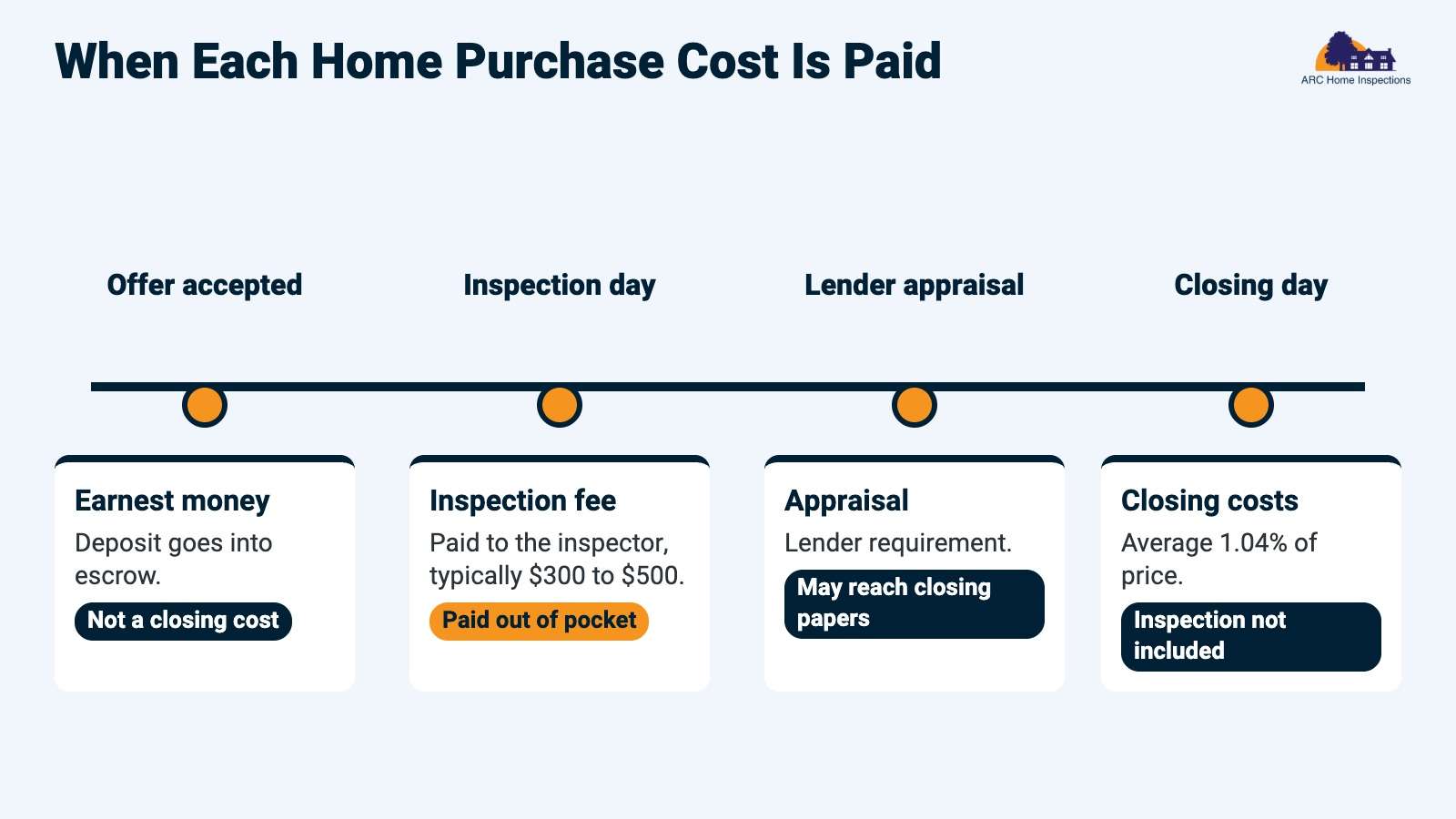
Cash due before closing includes these items:
- Earnest money, held in escrow.
- The inspection fee, paid to the inspector.
- Add-on test fees, paid to the same inspector or a lab.
- An appraisal fee, when the lender collects it upfront.
A companion guide on who pays for inspections explains the buyer and seller sides of this timeline. The figure below places each payment on the path from offer to keys.
That timeline separates the inspection from the appraisal, which does land near closing documents.
Is an Appraisal Part of Closing Costs?
An appraisal is a lender-required cost that can appear on the closing documents. A home inspection is optional buyer due diligence. Lenders order the appraisal to confirm the property’s value.
An appraisal measures the property’s value, while an inspection measures its condition. The lender needs the first, and the buyer chooses the second.
A separate comparison of inspection and appraisal reports covers what each document contains. The table below shows where each cost lands.
| Cost | Who gets paid | When it is paid | On the closing disclosure |
|---|---|---|---|
| General home inspection | The inspector | At the inspection | No |
| Radon, mold, well, septic or termite add-on | The inspector or lab | At the inspection | No |
| Appraisal | The appraiser, through the lender | At order or at closing | Sometimes |
| Seller credit | The buyer, as a reduction | At closing | Yes |
| Pre-listing inspection | The inspector, paid by the seller | Before listing | No |
The table shows one route for an inspection fee to reach the closing table, which is a pay-at-close arrangement.
Can You Wrap a Home Inspection Into Closing Costs?
A home inspection can be wrapped into closing costs only in rare cases. HomeLight says buyers can do this very rarely.
The question “is the home inspection included in closing costs” gets a yes when an inspection company offers a pay-at-close program. Hometeam, for example, lets buyers schedule an inspection and delay payment until closing. The company asks for the closing or title company details within five business days.
Inspectors collect payment at the time of service because billing at closing is very rare. HomeLight explains that inspectors view billing at closing as a conflict of interest.
The American Society of Home Inspectors (ASHI) Code of Ethics supports the same principle. The ASHI committee states that compensation for an inspection must be independent from inspection results. Payment that never depends on the sale keeps the report honest. The next question is whether the seller can take on the fee.
Can You Ask the Seller to Pay for the Home Inspection?
You can ask the seller to pay for the home inspection, and the purchase agreement must record the agreement. The NAR consumer guide says buyers could request that the seller pay.
A seller who agrees usually does so as a credit at closing, not by paying the inspector. The credit lowers the buyer’s cash due, while the buyer still pays the inspector on inspection day. A seller credit at closing is therefore one way an inspection cost can reach the closing table.
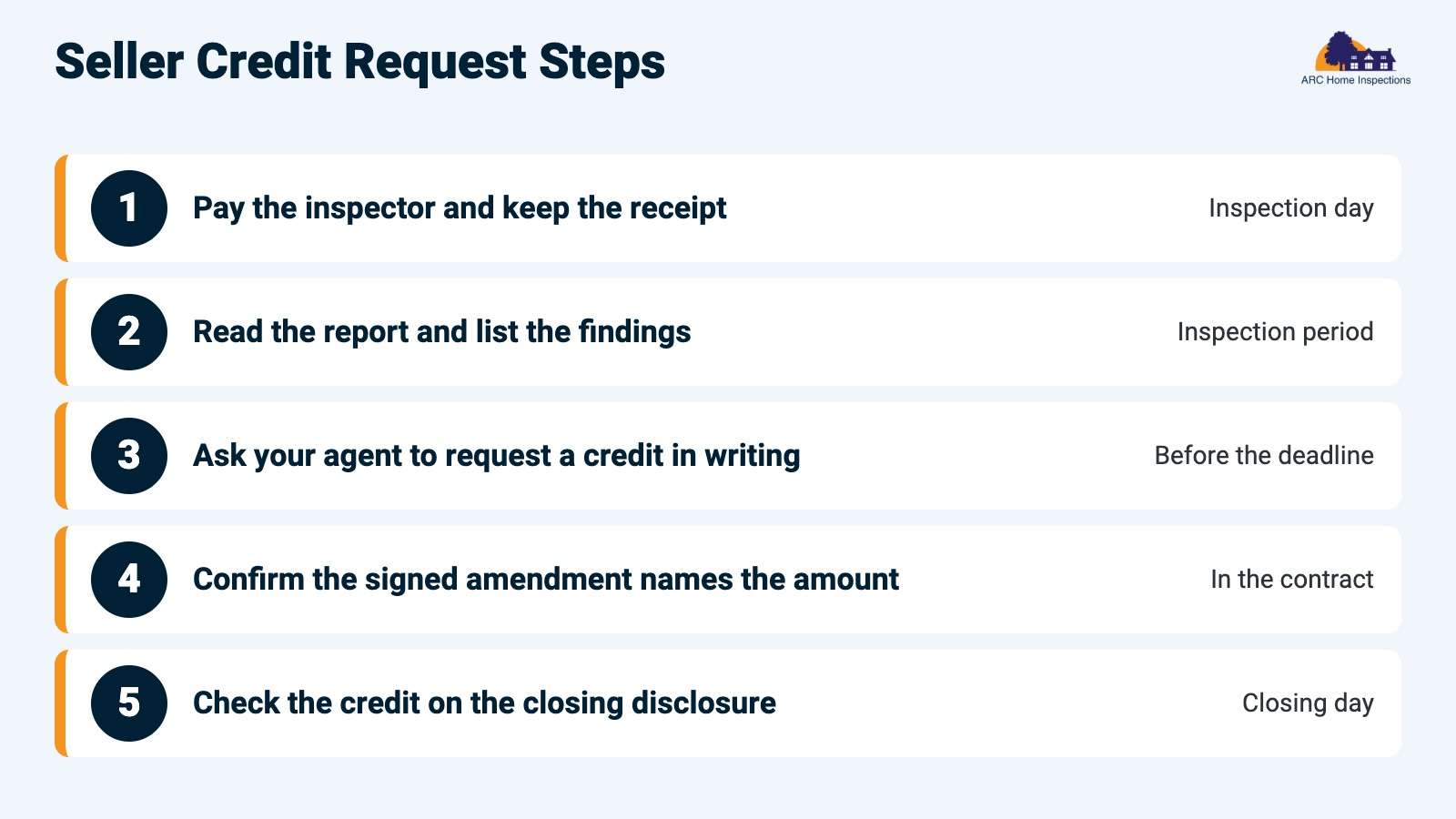
Buyers can request a credit in five steps:
- Pay the inspector on inspection day and keep the receipt.
- Read the report and list the findings that matter.
- Ask the buyer’s agent to request a credit in writing.
- Confirm the signed amendment names the credit amount.
- Check that the credit appears on the closing disclosure.
The five steps above appear in the graphic below for quick reference.
Buyers who want to negotiate inspection repairs can use the same written process for repair credits. The seller side of the transaction brings up a related question about pre-listing reports.
Does a Pre-Listing Inspection Count as a Closing Cost?
A pre-listing inspection does not count as a closing cost, because the seller orders and pays for it before listing. The seller pays the inspector directly, just as a buyer would.
Some sellers order a pre-listing inspection themselves, and a buyer may then reuse the report instead of ordering a new one. We perform a pre-listing inspection for sellers who want to know the home’s condition before the first showing.
Specialty tests add a second layer of cost, and buyers should know how those are billed.
Are Radon, Mold and Other Add-On Inspections Included in Closing Costs?
Add-on inspections such as radon, mold, well water, septic and termite checks are not included in closing costs. The inspector or lab bills each one separately, and the buyer pays at the visit.
Radon testing measures radon gas in the home’s air. The buyer pays for the radon testing separately, so the budget should include it from the start. The inspector places the device during the visit and sends the device for lab results afterward.
Mold testing checks air or surface samples for mold. A buyer who orders mold testing pays that fee out of pocket, separate from the loan. The fee covers sampling and the lab report, and the buyer pays it at the visit.
Well water testing sends a water sample to a lab for results. Homes with private wells need well water testing in addition to the general inspection, and the lab fee is separate. The lab report lists the contaminants found, and the buyer receives it with the inspection findings.
A septic inspection checks the tank and drain field of a home without public sewer. The septic system inspection carries its own fee, which the buyer pays at the visit. A seller may agree to a credit, but the contract must record that credit.
The purchase contract decides who pays for a termite inspection. A termite inspection for wood-destroying organisms (WDO) is billed on its own invoice, even when the seller agrees to pay.
Add-on fees raise the total cash due before closing. The final question is what happens to that cash when a deal falls apart.
Do You Lose Earnest Money After a Failed Home Inspection?
Earnest money after a failed home inspection depends on the inspection contingency in the purchase contract, not on closing costs. A contingency is a clause that lets the buyer cancel for stated reasons within a set deadline.
The inspection period sets the deadline for that decision. The contract language decides whether the deposit returns to the buyer. The inspector’s fee is a separate matter, because the inspector has already performed the work.
The inspection fee therefore stays with the inspector, even when the sale never closes. A buyer should read the contract language with the agent before the deadline passes.
How Much Cash Should You Budget Before Closing Day?
The cash to budget before closing day is the closing costs plus the $300 to $500 inspection fee. National Mortgage News reported that 2025 closing costs averaged 1.04% of the sales price.
As an illustrative calculation only, 1.04% of a $300,000 price is $3,120. The inspection fee comes on top of that estimate.
Closing costs can run higher or lower than the average, since the 2025 range reached from 39 basis points to 3.06%. Each add-on test adds its own charge. A buyers inspection booked early gives the buyer a firm number before the closing estimate is final.
Cash buyers still face these costs. The answer to “is home inspection included in closing costs” stays no for them as well. The next section covers more questions buyers ask.
What Else Should Buyers Know About Inspection and Closing Costs?
What Costs Are Not Included in Closing Costs?
Costs not included in closing costs are the down payment and any payment made outside the loan and transfer process. The CFPB definition excludes the down payment, and inspector fees are paid directly to the inspector.
Does Skipping the Inspection Lower Closing Costs?
Skipping the inspection does not lower closing costs, because the inspection was never a closing cost. A buyer who waives it saves only the inspector’s fee and gives up the report.
HomeLight quotes a NerdWallet report on 2020 offers. That report found 30% of successful offers waived the right to inspection in Boston, Portland (Oregon), DC and New Jersey. HomeLight also quotes NAR data that 19% of buyers waived inspection contingencies in November 2021.
Do Cash Buyers Pay for the Inspection at Closing?
Cash buyers pay for the inspection at the visit, the same way financed buyers do. A cash purchase has no lender fees, but the inspection fee stays the same.
Frequently Asked Questions About Inspections and Closing Costs
Do Inspections Count Toward Closing Costs?
Inspections do not count toward closing costs in a standard purchase. The buyer pays the inspector directly, and the invoice does not appear on the closing disclosure.
Can an Inspection Be Included in Closing Costs?
An inspection can be included in closing costs only through a pay-at-close program or a seller credit. Both options need agreement from the inspector or the seller in advance.
Does the Inspection Fee Appear on the Closing Disclosure?
The inspection fee does not appear on the closing disclosure unless the inspector bills at closing. A seller credit appears as a reduction, not as the inspection fee itself.
Is the Inspection Fee Refundable if the Sale Falls Through?
The inspection fee is not refundable when the sale falls through, because the inspector has completed the work. The fee stays separate from any earnest money decision under the contract.
How Do We Help Buyers Before Closing Day?
We help buyers before closing day by completing the inspection early. Costs and findings are then clear before the contract deadline. Radon, mold, well water, septic and termite testing can be scheduled during the same visit. Each test is billed on its own line. The buyer then knows every cash amount due before the closing estimate arrives.
Our buyer’s home inspection includes a detailed report that the buyer can share with an agent. Alan Redburn, an InterNACHI certified inspector, leads each inspection and explains the findings on site. Buyers get a report they can use to decide on repairs, credits or next steps.
Buyers across Missouri choose ARC Home Inspections for a clear, independent view of the home. The fee stays separate from closing costs. That separation keeps the report independent, whatever the answer to “is home inspection included in closing costs” turns out to be. Call us at (314) 948-3058 to book an inspection date.